

Pickleball Serve Rules
Before we dive into serving technique, it’s important to understand the basic rules of the pickleball serve. While some serving rules have changed over the years as the professional game has developed, the fundamentals remain largely unchanged. Below are the key rules every player should know before stepping onto the court.
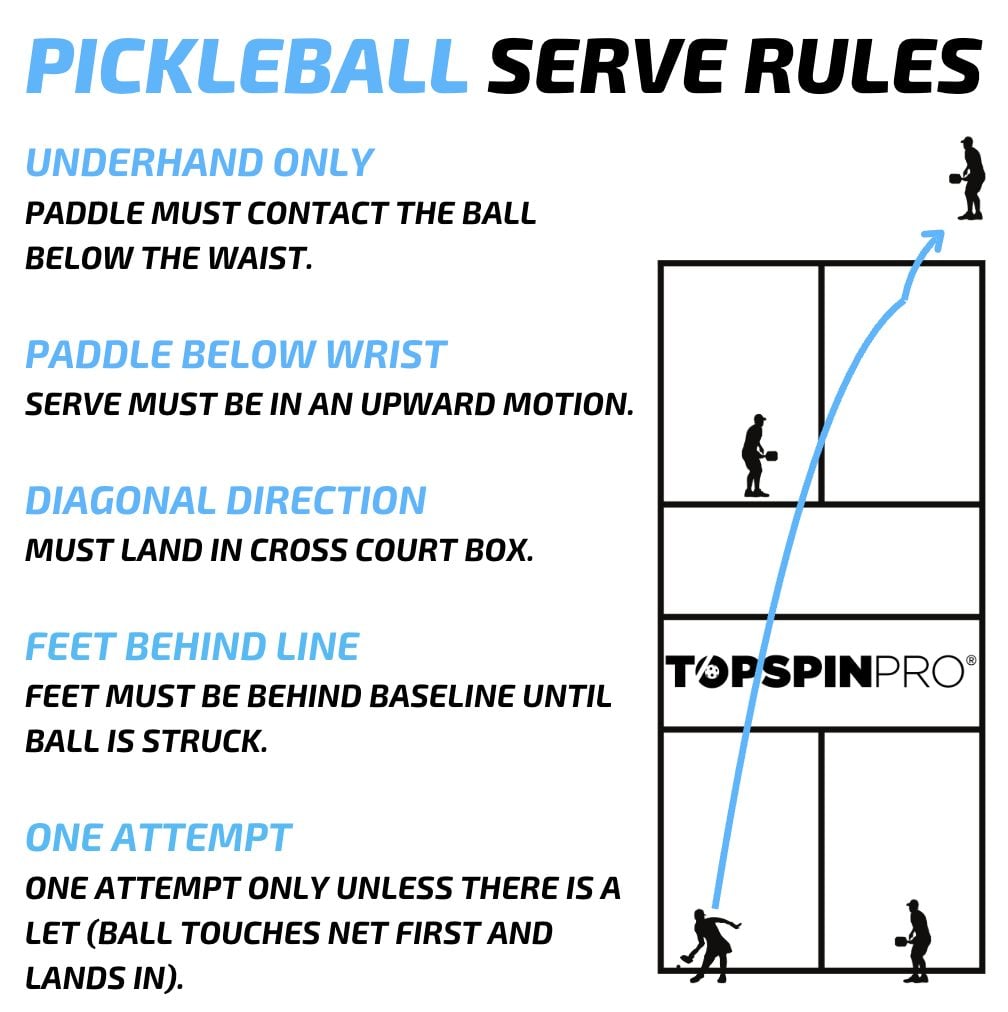
1. The Serve Must Be Underhand
The paddle must contact the ball below your waist (officially, below your navel). At contact, the paddle head must be below your wrist, must be moving upward through contact, and you cannot strike downward on the ball. So it must be a low-to-high action.
2. Feet Behind the Baseline
At the moment you contact the ball, at least one foot must remain on the ground. Neither foot can touch the baseline. Neither foot can land inside the court until after contact, and your feet cannot touch outside the imaginary sideline or centerline extensions.
3. Serve Diagonally
Every serve must travel diagonally across the court into your opponent’s service box. The ball must clear the kitchen (on the line is out) and land inside the opposite service box, inside the sidelines and baseline (on the line is in). If it lands on the kitchen line, it’s a fault. If it lands on any other line, it’s considered in.
4. One Serve Attempt
Unlike other racket sports, you only get one serve attempt. There are no second serves. If you miss, the ball goes to your opponent in singles or to your partner or opponents in doubles, depending on whether you are 1st or 2nd server.
The Fundamentals of a Great Serve
Before we look at the main types of serves in pickleball, let’s look at some fundamentals that should stay the same across all of them, even as the technique changes. When you watch the pros play, you will see that everyone’s technique is slightly different, depending on their grip, preferred stance, and their own personal style. But certain fundamentals stay the same:
1. A Routine
If you watch pro players, they will use a consistent routine each time they serve. This might be the way they walk up to the baseline, the way they take a breath, or the way they bounce the ball before hitting. It’s important to establish a routine that keeps you using the same tempo and timing for each serve. It’s easy to end up rushing when you are stressed and then make silly mistakes.
Figure out a routine that works for you to get you focused in the moment before you strike the ball. It could be something as simple as one bounce or tapping your leg with your paddle to get you in the moment.
2. The Stance
Your stance should stay the same, regardless of the service type you choose. This keeps your opponent from knowing what is coming and makes it easier to stay more consistent with your technique and rhythm.
3. The Grip
The grip can change depending on the type of serve you use. A continental grip works best for most beginners and is the most versatile grip in pickleball. If you are less experienced, then your grip should stay the same.
As you become more advanced, you can move the grip farther around the handle to generate more topspin.
Here’s an in-depth grip guide: How To Find The Best Pickleball Grip
4. Stay Loose
Power comes from your entire body, not just your arm. Stay relaxed throughout the motion so you can efficiently transfer energy through the kinetic chain, starting from the ground, moving through your legs, hips, and torso, and finally through the paddle. A loose, fluid swing generates far more power and consistency than trying to muscle the ball with your arm alone.
Types of Pickleball Serves
Different situations call for different types of serve. Here are the most common options for the recreational player using both topspin and slice and sidespin:
The Topspin Serve
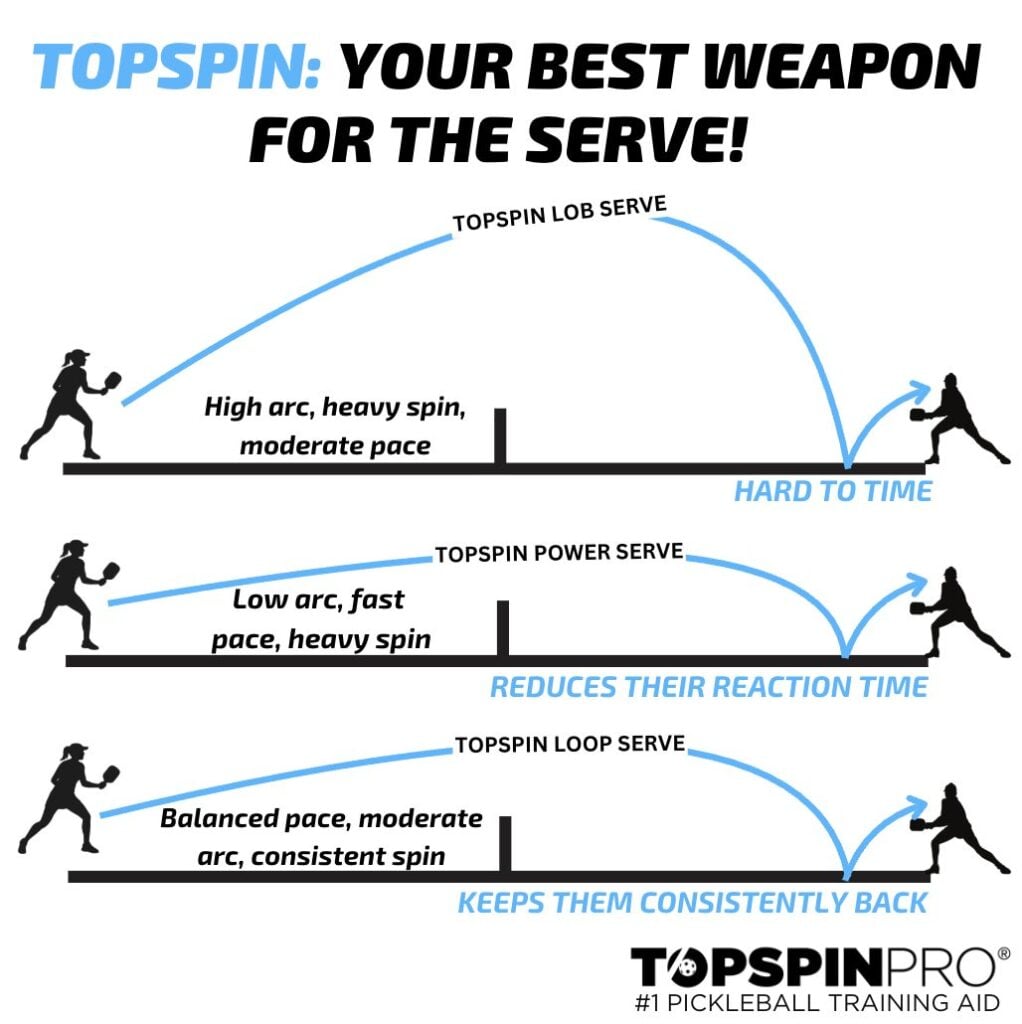
Topspin causes the ball to dip faster and bounce higher than an equivalent flatter serve, pushing your opponent back. It also means you can hit higher over the net and still get the ball in, making it a safer option. It allows aggressive serves while still keeping the ball inside the court.
Topspin gives you several options for your serve:
- A heavy aggressive topspin serve – push opponent deep with power and spin.
- A high looping topspin serve – push opponent back with height and throw off timing with medium pace.
- The lob serve – excessively high serve with lots of spin to throw off the opponent’s timing.
- The attack to the weaker shot serve – use heavy topspin to attack your opponent’s weaker shot and force a poor return.
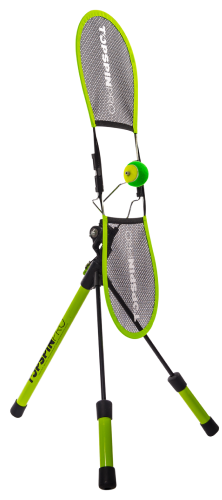
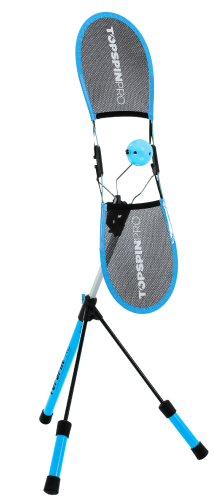
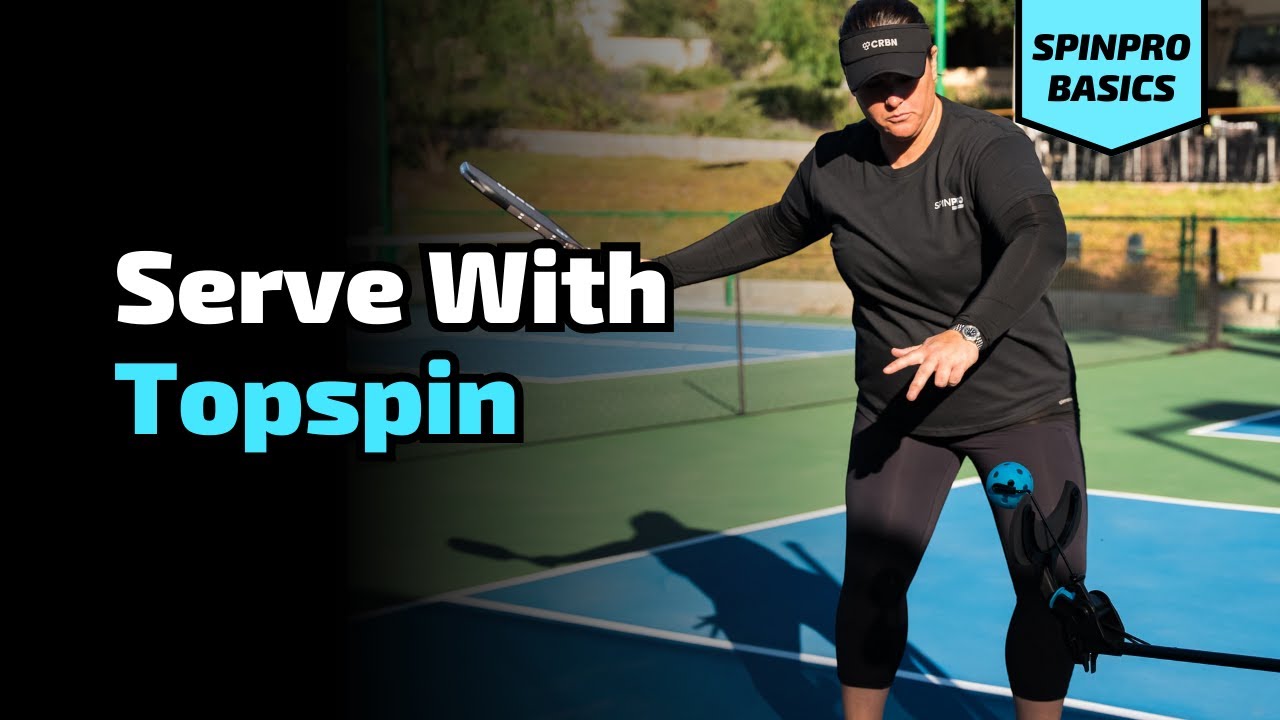
Here’s how you can learn the topspin serve on the SpinPro or TopspinPro.
The Slice/Sidespin Serve
Because a legal pickleball serve must be struck with an upward motion below waist level and with the paddle head below the wrist, it’s difficult to hit the back of the ball perfectly square. Instead, the paddle naturally moves slightly across the back of the ball during contact. This creates a combination of backspin and sidespin (often referred to as either a slice serve or a sidespin serve), with the ball spinning on a tilted axis. A serve can never be a pure slice shot, i.e., high to low, because that action would be illegal, meaning that all pickleball slice serves have some element of sidespin.
Depending on how the paddle travels across the ball, a serve can have either heavier slice or heavier sidespin. A slice serve curves slightly through the air and stays lower, and skids after bouncing. A heavier sidespin serve will curve more through the air and after landing (think “screwball serve’).
Slice/sidespin serves are particularly effective when hit wide, pulling your opponent off the court and forcing them to hit on the move. It can also be useful when swinging the ball into the body. Here are your main options:
- A heavy sidespin serve out wide – curves the ball away from the court and creates space between players and for your next shot.
- A short-angle serve – a shorter version of the wide serve. Forces your opponent out wide and short.
- The body serve – swing the ball in towards your opponent’s body to jam their return.
- The attack to the weaker shot serve – use heavy slice to attack your opponent’s weaker shot and force a poor return.
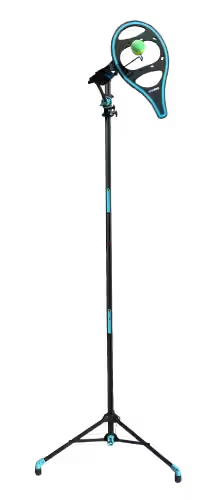
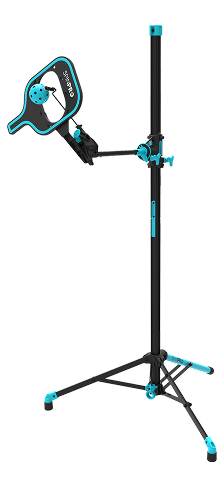
Here’s how you can learn the slice/sidespin serve on the SpinPro:

The Technique
No matter which serve you are hitting in pickleball, the generic technique will stay the same until the forward swing to contact. Here’s the best way to hit a pickleball serve:
Step 1: Pre-Serve Routine
We have already talked about having a repeatable routine before every serve. Begin every serve with the same routine, starting behind the baseline with your weight evenly distributed.
Hold the ball comfortably in your non-dominant hand.
Step 2: Drop or Toss the Ball
You have two choices for serving the ball. You can either let it bounce before hitting or hit straight from the toss (the volley serve). If you are a beginner and struggle with timing to take the ball straight out of the air, it might be easier to let it bounce. More advanced players use the volley serve. There are pros to each serve:
Advantages of the volley serve:
The volley serve can:
- Be slightly quicker and more compact.
- Allow a smoother rhythm.
- Feel smoother.
- Be struck higher up, meaning more power.
Advantages of the drop serve:
The drop serve can:
- Make timing easier.
- Be easier for beginners to learn.
- Keep the toss more consistent.
Step 3: Swing Upward
Whether you are applying topspin or slice/sidespin, your paddle must be moving upward. Avoid chopping downward when adding slices to the ball. This is the point where your swing will differ slightly depending on which serve you are hitting. If choosing top-spin, your low-to-high swing will be more exaggerated, trying to add maximum reps to the ball. The steeper the swing path, the more topspin you will get. Adding slice and sidespin to your paddle will have a much shallower, low-to-high action.
Step 4: Contact in Front
Strike the ball slightly in front of your body. This enables more power and spin and helps link the whole kinetic chain together. For the topspin serve, the contact will be on the back of the ball. For the slice and sidespin serve, your contact will be lower on the ball and slightly inside (left or right for right-handers, and right for left-handers).
Step 5: Finish Toward Your Target
Either finish with your paddle towards your target placement area or finish over your opposite shoulder with your elbow pointing to the target. Your upper body and hips should also finish square to the target area.
Here are some drills to help you practice this:

Common Serving Mistakes
1. Serving Too Soft
Serving too casually and not putting pressure on your opponents makes the return too easy, especially if the ball lands shorter. Focus on maintaining good paddle head speed and applying some topspin to keep the ball under control.
2. Serving Too Short
Short serves usually result from soft serves or low serves. Aim to keep the ball deep and your opponent’s back. Try to keep the ball bouncing within a few feet of the baseline.
3. Looking Up Too Early
Keep your eyes on the contact point until after impact. Lifting your head too early can pull the ball high and throw you off balance.
4. Tight Grip
A tense grip reduces paddle speed and touch. Try to hold the handle with a nice, relaxed grip and stay loose throughout the swing.
5. No Variety
If every serve is identical, opponents quickly adjust. Try mixing up height, speed, spin, and placement to keep them on their toes.
Final Thoughts
The serve is much more than a way to start the point. It’s your first opportunity to gain an advantage. By developing a reliable technique, understanding the rules, and learning when to use different types of serves, you can put immediate pressure on your opponents and set yourself up for success.
The goal isn’t to hit an ace every time, it’s to make every return just a little more difficult. Over the course of a match, those small advantages add up to more free points, easier thirds, and more wins.
Whether you’re playing recreationally or competing in tournaments, investing time in your serve is one of the fastest ways to improve your overall pickleball game.
FAQs
-
What are the basic rules of a legal pickleball serve?
The serve must be underhand, with the paddle contacting the ball below your waist and the paddle head below your wrist. Your paddle must be moving upward through contact, and you cannot strike downward on the ball.
-
Where should my feet be when I serve?
At contact, at least one foot must stay on the ground and neither foot can touch the baseline. Your feet also cannot land inside the court or touch outside the imaginary sideline or centerline extensions until after contact.
-
Does the serve have to land in a specific box?
Yes, every serve must travel diagonally into your opponent’s service box. It must clear the kitchen, and if it lands on the kitchen line it’s a fault; on any other line, it’s considered in.
-
Do I get a second serve in pickleball?
No. Unlike other racket sports, you only get one serve attempt, so a missed serve gives the ball to your opponent in singles or moves to your partner or opponents in doubles, depending on the server position.
-
Why is a pre-serve routine so important?
A consistent routine keeps your tempo and timing the same each time you serve. It helps you avoid rushing when you are stressed and making silly mistakes.
-
What grip should beginners use for serving?
A continental grip works best for most beginners and is the most versatile grip in pickleball. If you are less experienced, keep your grip the same rather than changing it for different serves.
-
How can I get more power without muscling the ball?
Stay loose. Power comes from your entire body, starting from the ground and moving through your legs, hips, torso, and finally through the paddle, so a relaxed, fluid swing gives you more power and consistency than using your arm alone.
-
When should I use a topspin serve?
Use topspin when you want the ball to dip faster, bounce higher, and push your opponent back. It lets you hit higher over the net while still keeping the ball in, making it a safer option for aggressive serves.
-
What makes a slice or sidespin serve effective?
A slice or sidespin serve can curve through the air, stay lower, skid after bouncing, or move like a screwball serve. It is especially effective when hit wide to pull your opponent off the court, or into the body to jam their return.
-
What are the most common serving mistakes to avoid?
Avoid serving too soft, serving too short, looking up too early, gripping too tightly, and giving your opponent the same serve every time. Keep the ball deep, stay relaxed, watch the contact point, and mix up height, speed, spin, and placement.
Enjoyed this article?
Be sure to sign up for our newsletter and we'll keep you up to date about new posts