
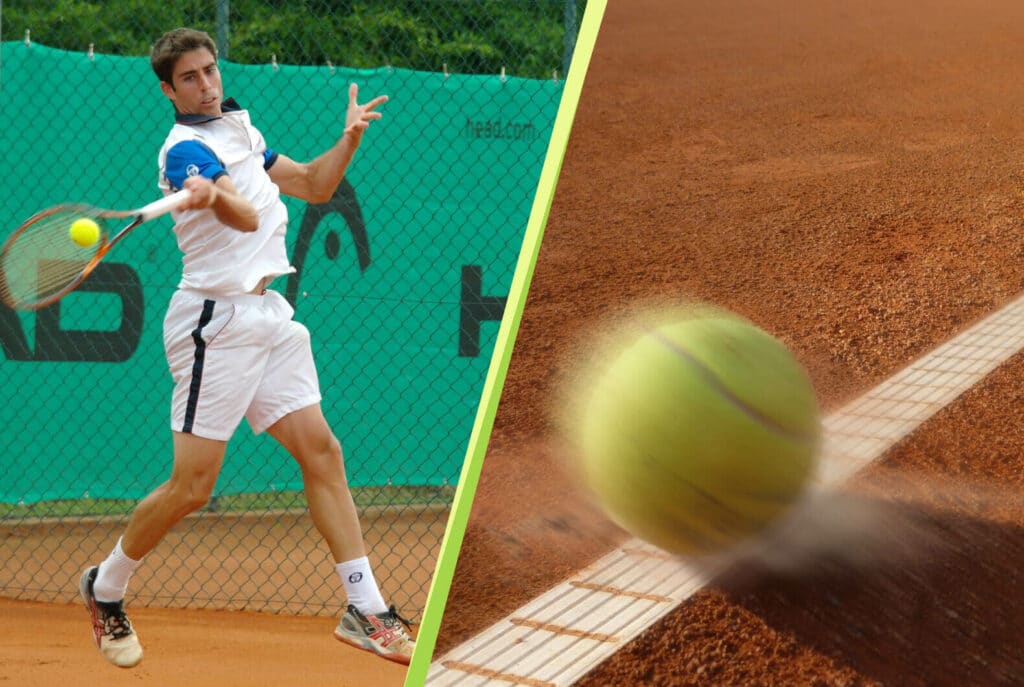

Most tennis players have heard of topspin and know it’s something they should be using in their game. Ironically, though, when questioned, a good portion of them cannot explain what it is. Understanding the finer details of your sport is crucial to the ongoing development as a player. If you don’t know “why” you do it, then it’s probably impossible to know “how” to do it effectively. Consequently, much of your game can then rely on chance rather than strategy. So let’s get down to the nitty-gritty.
When playing a regular game of tennis, you can control the tennis ball in 5 ways:
- direction
- speed
- height
- depth
- spin
Learning these is essential to having a solid foundation as a player and reaching at least a reliable intermediate standard. However, mastering spin is perhaps the most important and difficult stage. Applying it also gives you an extra dimension of control over the other 4 components. By blending in varying amounts of spin, you can adjust speed, direction, height and depth.
What Is Topspin?
The two main types of spin in tennis are topspin (the forward rotation of the ball) and backspin (the backward rotation of the ball).
Topspin is used in a variety of sports, including baseball (pitcher), cricket (bowler), football (free kick) and snooker. As a matter of fact, topspin was popular in these sports many years before it was used in racket sports.
The name topspin implies that you hit the top of the ball, which in other sports is true, but not so much in racket sports, where we are generally trying to lift the ball. They should have renamed it forwardspin to avoid the confusion of many players and coaches!
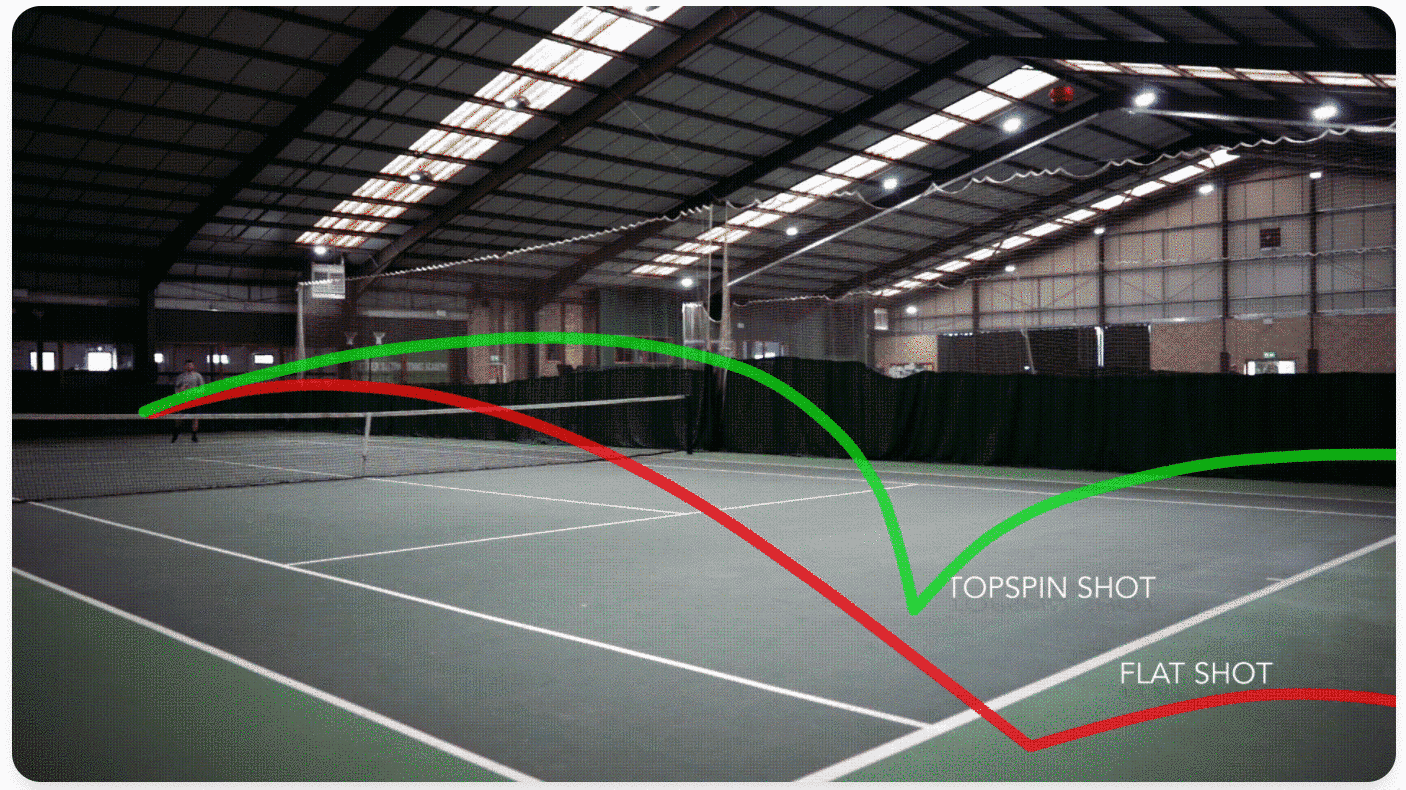
The forward rotation of the ball during topspin causes something called the “Magnus Effect”, which is a downward force caused by the interaction between the rotating ball and the air. Because topspin helps the ball dip into the court while still allowing pace and net clearance, the vast majority of modern baseline groundstrokes are hit as topspin or drive shots rather than slices.
Why Do We Use Topspin?
Topspin has two main effects that we can use to our advantage – one that makes life a lot easier for you (sending the ball) and one that makes life very difficult for your opponent (receiving the ball).
Topspin isn’t just a flashy skill; it’s one of the most important tools for consistency and control in tennis. It causes the ball to dip faster than a flat shot. That gives you more margin for error and lets you:
✅ Hit higher over the net without going long
✅ Strike with more power while keeping the ball in play
✅ Open up wider, sharper angles
✅ Create heavier, more difficult shots for your opponent
Offence
Topspin expands your offensive options. With reliable spin, you can hit deep, aggressive groundstrokes that push opponents back, attack cross-court or down the line with pace and control, dip balls at your opponent’s feet, making net-rushers uncomfortable, use lobs, topspin passes, and sharp angles more effectively
Defence
Defensively, topspin buys you time, helping you recover quicker, reset rallies, or counterattack. It gives you more options to stay in the game and keeps you from panicking!
In short? Topspin gives you freedom: to attack, defend, and control the game on your terms.
Consistency & accuracy
Topspin allows you to hit the ball much higher above the net (less chance for error) and still land well before the baseline (less chance for error)! It allows us to “bend” the ball in an arc shape (see the image above).
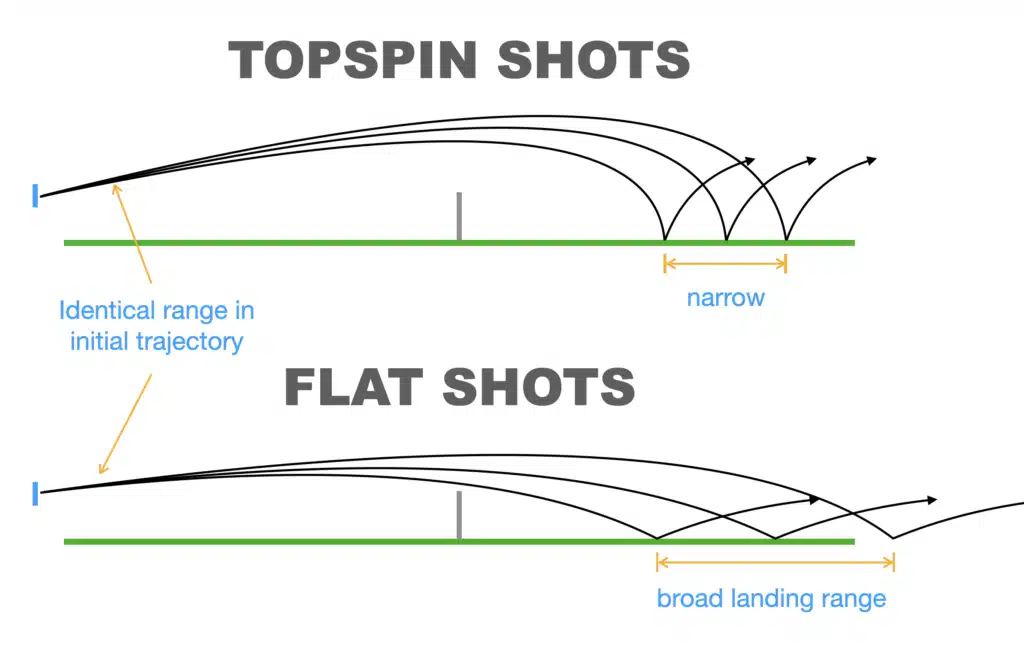
This near ‘vertical’ dropping of the ball just before it bounces is what enables us to be a lot more accurate with topspin.
Notice in the image below, for 3 identical variations in contact angle or initial trajectory, how much closer together the ball ‘landing points’ are with topspin relative to shots hit without spin.
Not only does this mean we can hit the ball harder, but it also opens up a new world of opportunity for angles. The arc-shaped flight path means we can:
- Hit deep shots safely
- Dip the ball closer to the net player’s feet
- Create wider angles off the side of the court
- Bring aggressive lobs back down
- Hit down-the-line approach shots that dip before the baseline
All things that are simply impossible with a flat shot.
We can move our opponents around the court much more aggressively by applying that topspin.
Just think of how much more athletic modern tennis players look compared to the days when topspin was just becoming popular in the 1970s. That’s partially because they have so much more ground to cover.
The evolution of topspin and technology has had a direct impact on the development of tennis players as athletes, with polyester strings helping unlock the spin-heavy modern game.
Kick
The forward rotation of the ball and the fast dip create a much more aggressive bounce – a higher trajectory that rips off the court (see diagram above). This ‘kick’ makes life difficult for your opponent in several ways:
- It pins them further back in the court, so they have less opportunity to attack
- It forces them to play shots above the strike zone (hip to shoulder)
- It makes timing the ball harder – they’ll make contact late more often
Topspin is therefore crucial to winning points. It’s also extra effective on slow, high-bouncing surfaces such as clay. That is why players who grew up playing on clay courts tend to hit greater spin rates than those who did not. Rafa Nadal is the greatest example.
So topspin gives us two big advantages: a safer flight path and a more difficult bounce. But those advantages only matter when they are attached to a clear intention. That is where the tactical side of topspin becomes so important.
How Do We Create Topspin?
A common misconception is that topspin is created by rolling the racket face over the top of the ball. Ian Westerman does a great job of explaining why this is not what happens and is, in fact, physically impossible.
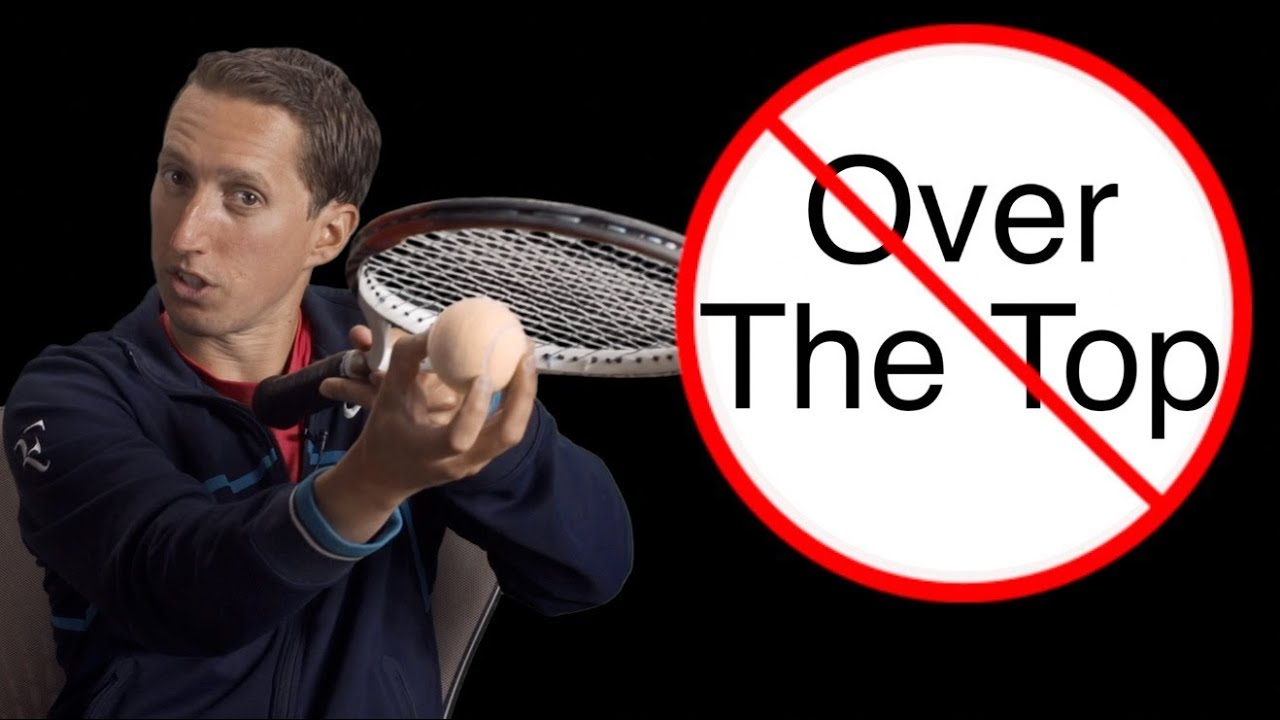
Friction occurs when the strings contact the tennis ball. Moving the strings upward with that friction causes the ball to rotate forward, creating topspin. The faster your strings travel up the ball, the more friction and spin you create.
Visualise trying to slide up the back of the ball vs hitting it.
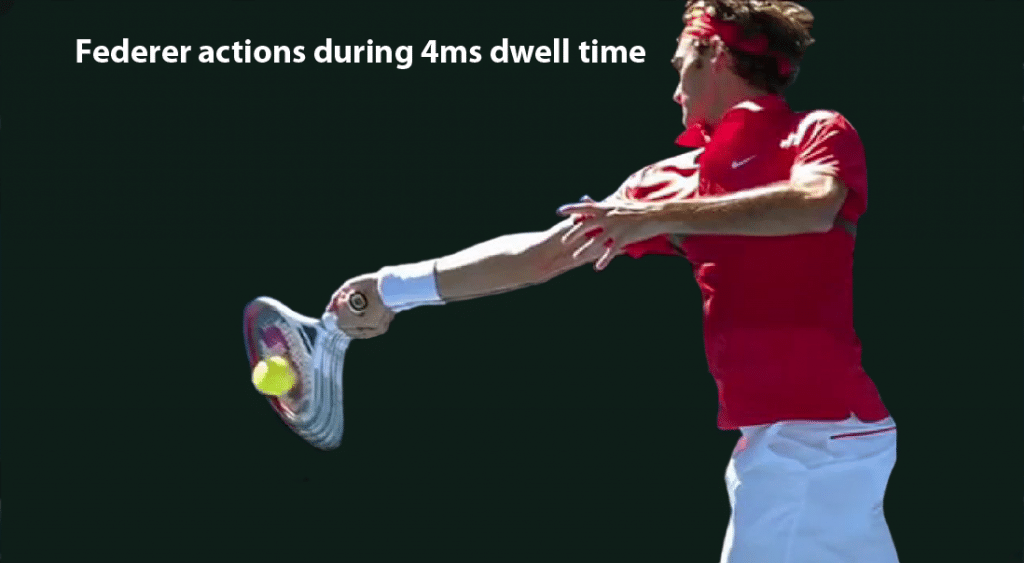
Let’s look at that a bit more closely:
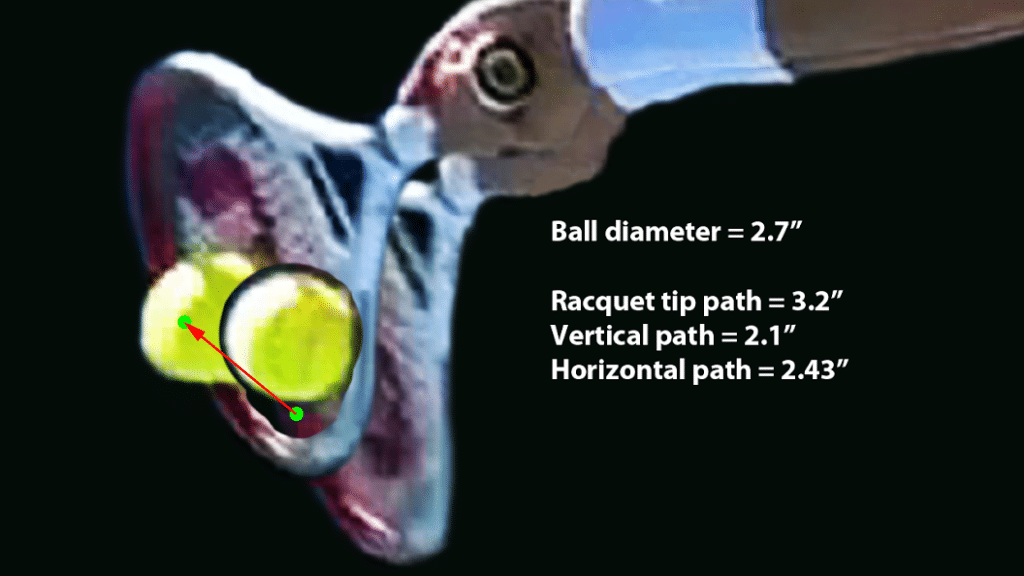
That view makes it look easy. But to deliver the racket face to move up like that in the strike zone, you need a certain type of swing path. The typical swing path of a topspin groundstroke is around 40 to 60 degrees.
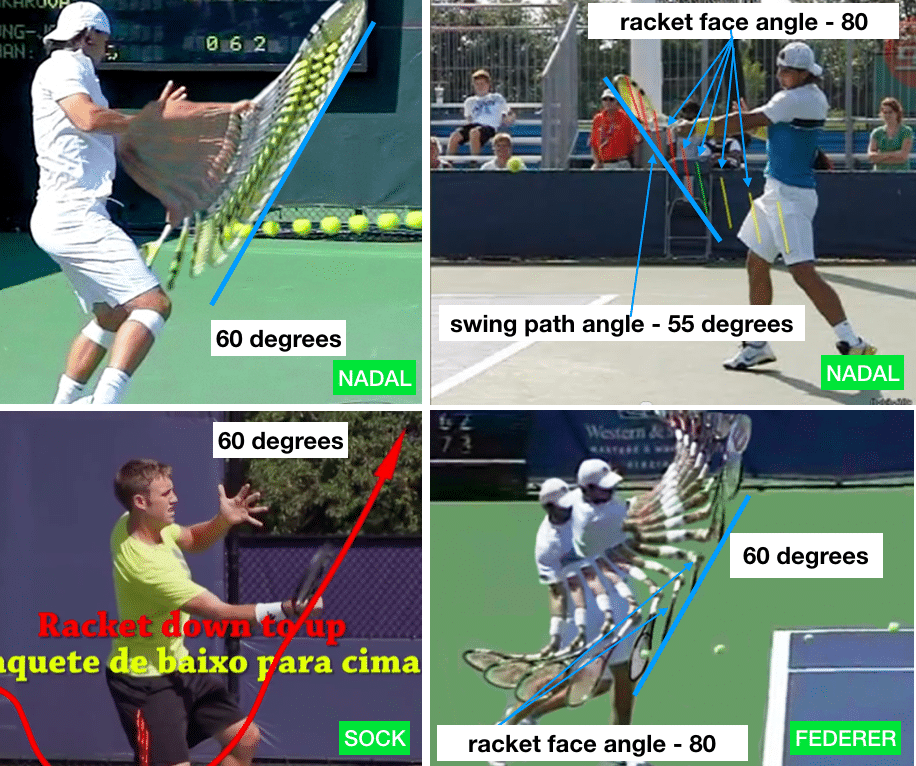
Tennis Analytics produce wonderful images of pro players’ swings that make it very easy to see what the racket is doing during the swing and why the forehand is so often called the windshield-wiper stroke.
And you can see it even more clearly here in this clip from Simon and Alex at Top Tennis Training.
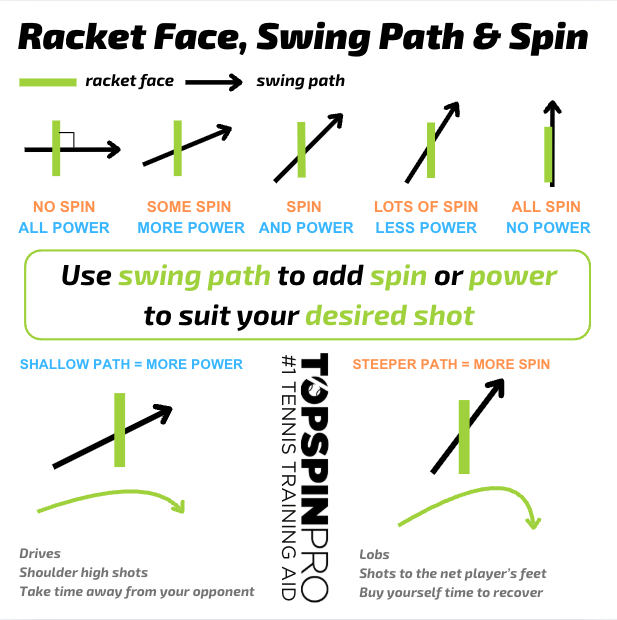
Bear in mind that if you come too sharply up the back of the ball, then you will have too much spin and the ball will drop prematurely. So, hitting a topspin shot is actually a combination of an upwards and a forward swing (see the chart below).
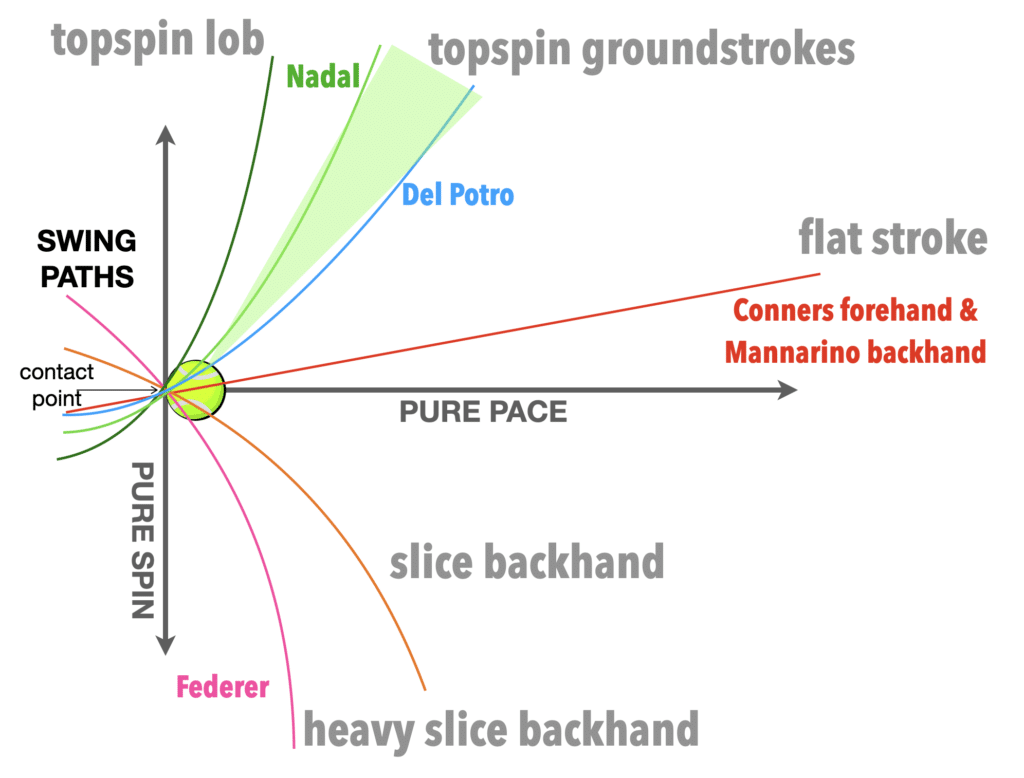
Learning to control these two together is one of the hardest parts of mastering spin. So while there are several elements common to all topspin groundstrokes, it is the ability to master mixing the spin component with the forward swing that adds so many more options to your arsenal.
This is how we adjust the speed, depth, height, direction, and spin discussed previously. Every single shot you hit during a match will be a unique blend of the two, depending on what you want to do to the ball.
Common Mistakes When Adding Topspin
Topspin is incredibly useful, especially under pressure, but only when applied with the right technique. When players try to force topspin without understanding the proper mechanics, it leads to loss of control, bad habits, and even injury.
Here are some of the most common mistakes:
Hitting The Top Of The Ball
The name “topspin” can be a little misleading. It sounds like you’re supposed to hit the top of the ball, and in some sports, that’s partly true. But in tennis, that approach won’t work. To generate effective topspin in tennis, you actually need to roll your strings up the back of the ball, not strike the top. Topspin is created with friction, as your strings travel from low to high, lifting the ball upward and forward in one smooth motion.
👉 If you try to hit the top of the ball, you’ll simply drive it downward, causing it to drop short or hit the net.
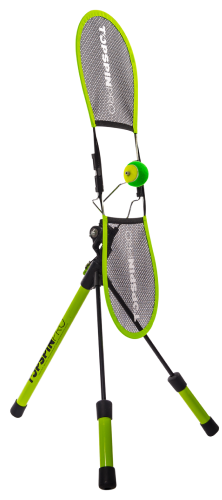
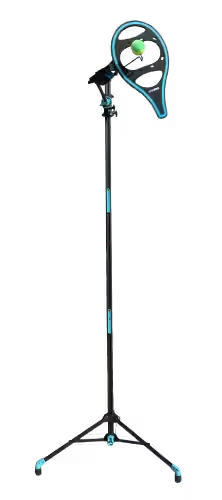
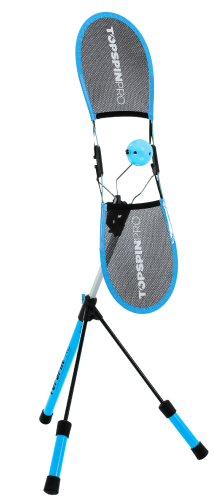
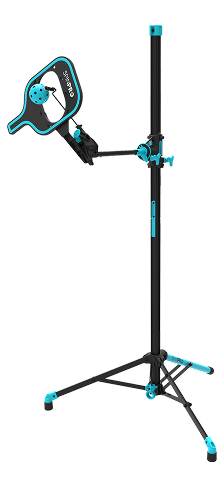
By learning to hit up the back instead, you’ll develop a true topspin shot that gives you both safety and attacking potential, and that’s where tools like the TopspinPro really shine, by reinforcing the correct biomechanics.
Swiping Across the Ball
Many players end up exaggerating their swing and swiping across the ball, forcing the finish. This leads to mishits and shanks, a lack of control and depth (tends to send it low and cross-court with sidespin instead of true topspin).
👉 Focus on a low-to-high swing path, rolling strings up the back of the ball and a high finish.
Overusing the Wrist
A wristy flick might feel like it’s adding spin, but in reality, it often adds unnecessary stress to the wrist and forearm without creating reliable topspin. It’s one of the most common misconceptions among players trying to learn topspin. Many players see the racket “whipping” through contact and assume the wrist is actively doing the work, but that’s not the case.
While the wrist stays relaxed, it should remain stable through contact, allowing the racket to move around it naturally. That “whip” effect actually comes from pronation in the forearm and a fluid kinetic chain, not from snapping or forcing the wrist.
👉 If you want to feel the correct motion without overusing your wrist, tools like the TopspinPro can help you build the right biomechanics safely and consistently.
Late Contact Point
When players try to exaggerate topspin, they often fall into the trap of swinging too steeply with a “buggy whip” type finish, where the racket wraps up and around the head after contact. This can feel flashy, but it often causes late contact and poor timing, especially for recreational players.
The buggy whip can be effective in very specific situations, which is why you’ll sometimes see pros use it. It’s especially useful when they’re under pressure, and the ball is rising fast, and they need to improvise, or they’re dealing with a low ball that needs extra lift.
But here’s the key: pros use it as an adjustment, not a default swing. For the average player, copying this style too early often leads to inconsistent contact, poor balance and less power and control.
Instead, focus on mastering solid fundamentals first with one clear, efficient swing path. It’s important to aim for correct biomechanics that give a consistent contact point, a smooth low-to-high motion and a clean, repeatable finish. Repeating the same swing will improve your tennis game faster. Once you’ve built reliability and control with that core swing, then you can explore variations like the buggy whip for specific tactical situations.
For more tips, read our guide on How To Improve Tennis Fast: Tennis Skill Progression Guide
👉 Aim to make contact consistently out in front of your body
5. Tensing Up Or Forcing the Shot
Topspin doesn’t come from muscling the ball; it comes from fluid, well-timed movement. When players try too hard to generate spin, they often grip the racket too tightly, tense up through the shoulders, and rush the swing. The result? A stiff, jerky motion that actually reduces spin, control, and power, the exact opposite of what they’re trying to achieve.
If you’ve ever watched top-level junior players or pros, you’ll notice they often look incredibly relaxed, almost floppy, like they’re barely holding the racket. But that looseness is exactly what allows them to generate maximum racket head speed, meaning effective power and topspin.
👉 Relax your grip, breathe through the swing, and trust your technique. Playing with compression balls can help develop a loose swing.
Check out our in-depth guide to Common Topspin Forehand Mistakes: What’s Holding You Back?

How to Hit With More Topspin and Stay in Control
Now that you are aware of some common mistakes and tips to help avoid them, let’s look at other key adjustments that can unlock reliable, controlled topspin.
Get The Biomechanics Right
As we have already discussed, topspin is created by brushing up the back of the ball, not hitting flat through it. Master the correct contact-point biomechanics, and you will improve quickly!
Also, understanding the physics of the swing will help you advance faster (see the image below). Knowing what you are trying to achieve translates to the correct swing shape.
This is where the TopspinPro can transform your game. Instead of guessing or hoping your technique is right, the TopspinPro trains the exact path of the racket at contact and the ideal racket face angle to achieve maximum topspin.
Use Your Whole Body
Proper body positioning and footwork are essential for generating topspin and maximising power through the kinetic chain, the sequence of movements that transfers energy from the ground up through your body and into the racket.
Real topspin starts from the legs, not the wrist or arm. It’s all about harnessing your full body efficiently:
- Load your legs and stay balanced
- Use a unit turn on your backswing to engage your core
- Uncoil through the shot in a smooth, relaxed motion
When players first try to add topspin, they often tense up, afraid that using more power will make them lose control.
Ironically, the more you engage your entire body, the easier it is to produce controlled, heavy topspin. The extra spin gives you more margin for error, not less.
Focus on rhythm over force. Let your body work as a connected system, and you’ll find that spin, power, and control all start to fall into place.
Practice The Correct Way
Don’t expect a miracle. Nothing in life comes without hard work, and the same applies to your tennis game. Put in extra practice, and you will be rewarded, but make sure that practice is structured and relevant. There’s no point rushing to matchplay when you haven’t mastered your topspin yet. Technical and drill progressions are key here.
Read our full guide: How To Improve Tennis Fast: The Skill Progression Guide
Tactical Intention and Topspin
Now we know that each shot you hit is unique, it’s also important to emphasise that you cannot do this successfully without a plan. It’s fairly common in tennis, especially up to the intermediate standard, for players to just “hit” the ball. Basically just swinging at it with no clear intention. This can be surprisingly successful, especially if you are a consistent hitter, but without real clarity, you are not going to level up your tennis and win more matches.
Hitting lucky winners is great, but it’s far more useful to know why.
So, to apply that unique blend we talked about and to really be successful with moving the ball around, each shot must have a clear directive.
If you are going to lob, you need a steeper swing path. If you are running to hit a high-bouncing short ball, you may have to take it earlier and higher than usual.
If your opponent has pulled you out wide, then a slow looping deep topspin shot can buy you time to recover to a more central position in the court. Each shot presents a different situation.
Having the awareness to adjust your technique accordingly and capitalise on the context is a considerable asset.
What is Tactical Intention?
Tactical Intention is the ability to approach each shot with a clear objective in mind. It can be as simple as aiming to hit cross-court to maintain control of the rally or looping a ball to give you more time to recover. Tactical intention enables you to execute your shots to the best of your ability.
By developing tactical intention, you transform your game from reactive to proactive, allowing you to dictate play and exploit your opponent’s weaknesses.
Why is Tactical Intention Important?
To successfully implement topspin and gain a tactical advantage, every shot must have a defined purpose. Simply hitting the ball without intent means you lack clarity on the technique required for the shot.
For example, if you want to execute a cross-court topspin forehand lob, you need to understand the mechanics behind it, such as dropping your racket below the ball and swinging steeply up the back of it. Without a clear tactical intention, applying the correct technique becomes difficult, leading to inconsistent and ineffective shots.
Mastering this combination will elevate your consistency, shot selection, and overall effectiveness on the court.
Here are eight common intentions where topspin gives you a tactical edge:
1. Buy yourself more recovery time
The option to hit the ball with extra height gives you more time on tough shots. If your opponent stretches you wide off the court, a higher topspin reply can keep the ball safe, push them back, and give you time to recover towards the middle before the next shot.
2. Push your opponent back off the court
The topspin kick after the bounce means your opponent often has to contact the ball further back than they would against an equivalent flat shot. That can pull them out of their attack zone, force a late contact point, and open more court space for your next ball.
3. Hit more aggressive lobs
The topspin lob is one of the most exciting shots in tennis. A flat or sliced lob is often a defensive escape, but topspin lets you add pace and still bring the ball down. When Andy Murray spun that backhand lob over David Goffin’s head, Goffin could only watch it dip back into the court and kick away from him.

The slice and flat lob still have their place, especially when you are stretched or the ball is behind you. But when you have time and can attack, the topspin lob lets you be much more aggressive.

4. Dip the ball at a net player’s feet
Against an opponent at the net, one of the best tactics is to make the ball drop at their feet. The dip created by topspin lets you aim lower and still clear the net.
- They have to volley the ball back over the net, which can leave the next shot sitting up in your attack zone.
- An upward volley usually has less power, so you are less likely to be punished.
- A low ball is harder to reach and control well, especially for taller players who have to bend more.
5. Create wider angles
Because topspin makes the ball dip, you can play shots closer to the net and still bring them down inside the court. That means shorter, wider angles that would drift into the alleys or beyond the sideline if you hit the same shot flat.
6. Control aggressive short balls and approach shots
Topspin lets you move forward and stay aggressive without simply chipping, floating, or hoping the ball drops in. You can attack from closer to the net, keep racket speed through the shot, and still have the spin bring the ball down before the baseline.
7. Lift low balls with pace
When the ball stays low, you still have to lift it back over the net. If you hit that ball flat, you often have to take pace off to avoid missing long. Topspin lets you lift with aggression instead of floating a slower ball that gives your opponent time.
8. Bend the ball
Topspin can also be mixed with sidespin to bend the ball back into the court. That is what makes certain passing shots possible, like curling the ball around a player at the net or even around the net post.

Tactical Intention in Action: Applying Topspin
Let’s now look at some tactical intention examples and how you would apply topspin accordingly:
- The Defensive Lob: When under pressure, choosing to hit a high-arcing topspin lob can push your opponent back and give you time to recover to a better court position. It’s also useful when your opponent has approached the net. Technique: Drop your racket low below the ball and swing steeply up the back, finishing high. On the forehand side, the buggy whip technique can help. Accelerate with a medium-to-medium-fast swing to add extra topspin.
- Moon Ball: If you’re pulled out wide, a slower to medium-paced, looping topspin shot can land deep with a high bounce, allowing you valuable seconds to reset to a more central position. It can also be a good tactic to get your breath back on a couple of points. Technique: Accelerate up the back of the ball to apply spin, but not as steeply as the lob.
- Aggressive Groundstroke: If your opponent is landing their shots into a zone that is easy to attack then you want to capitalize on this. You can do this by adding a good blend of topspin and pace. Technique: Extend and accelerate your racket forward while simultaneously rolling up the back of the ball. Be precise with which part of the ball you are striking to aim the ball.
- Wide Angle: When pulled wide of the court yourself, it opens up the opportunity to hit even wider. Technique: Strike on the outside of the ball to achieve the angle direction and swing steeply up the back of the ball while swinging forward, but not too much. The blend of swing needs to allow for a dipping shot and a short ball flight.
Each situation in a match requires adaptability and awareness. The ability to recognize shot opportunities and adjust your swing accordingly is a major asset.
Developing Topspin for Tactical Intention
When practising your groundstrokes, don’t limit yourself to hitting from the baseline. In a match, you’ll find yourself striking the ball from various positions on the court, and no two shots will ever be identical. So it’s crucial to be able to select from an arsenal of options. Having the ability to hit topspin in multiple ways means you can choose a tactical intention for most situations and then apply the correct technique.
Here are a some ways to help develop your control with topspin:
- Service Box Rallies and Points: Spending a good amount of time rallying in the service boxes as well as playing competitive points is a great way to develop your swing control. The shorter court and angles needed to move the ball around help you build up the muscle memory for dipping the ball, creating angles and controlling the depth with topspin. This takes a lot longer to develop from the baseline.
- Ball Machine/Rally Practice: Spend a good amount of time hitting from different locations on the court. Practice controlling the depth and angles using topspin. You ability to blend pure speed and topspin is crucial so spend a good amount of time on that. It’s important to be able to change the pace and topspin levels from shot to shot.
Developing Tactical Intention Skills
To enhance your decision-making and shot execution, consider practising some of the tactical scenarios below. The more you practice these, the more readily you will be able to recognise your current situation and call upon them:
- Defensive Play: If under pressure, hitting a deep topspin shot buys you time to recover and resets the rally. You can use a lob or moon ball type of shot.
- Return Offensively: Returning offensively, especially off the second serve, can win you a lot of quick points. Practice returning with angles from a wider serve and deep with heavy topspin and pace off a more central serve.
- Cross Court Consistency: Hitting cross-court is the safest direction. Practice becoming solid and consistent. This is a shot you should aim to never miss unless under a lot of pressure. If you are having a tough match, it sometimes pays to just stay consistent and hit everything cross-court.
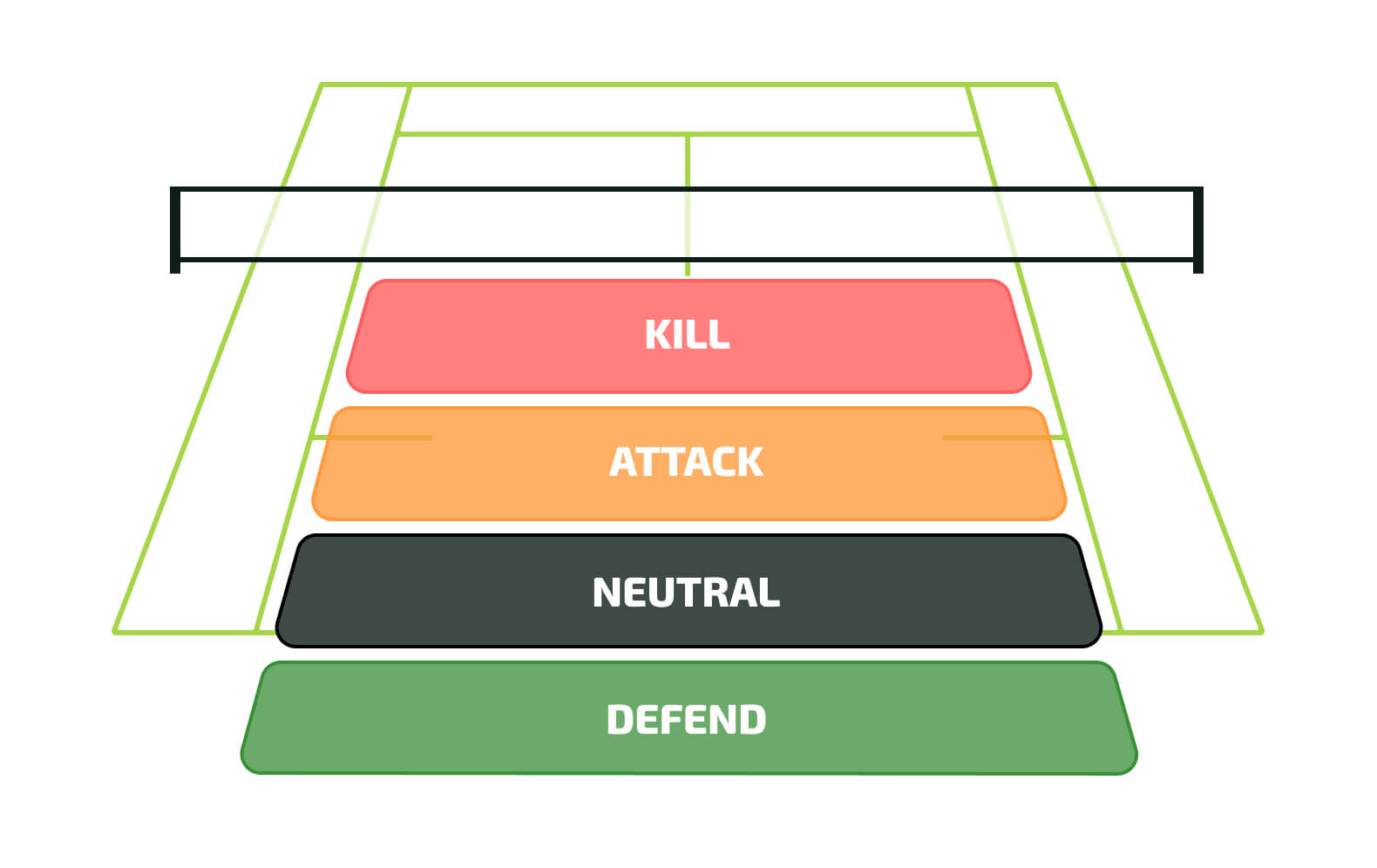
- Mid Court Attack: Practice seeing short balls early. Having the ability to pounce on these quickly and take them at the top of the bounce means you can hit a more aggressive trajectory on your shot. If you are unsure of which balls are best to attack, see the image below. This shows you, in general, which position you would be in when striking the ball in these zones.
- Mixing Pace and Spin: Train a series of shots that mix up the pace and spin you apply. This will disrupt your opponent’s rhythm and can be a great tactic against a player who thrives on maintaining it.

Try some of these scenarios and put together your own that match the style of play you prefer.
Bonus: Topspin is Kinder on Your Body
There is also a physical benefit when topspin is produced with good mechanics. A smooth kinetic chain lets your legs, hips, trunk, arm, and racket share the work, rather than forcing spin from a single joint. That does not mean topspin magically prevents injuries, but it does mean the goal is a relaxed, connected swing – not a last-second wrist flick that piles stress into the wrist and forearm.
Wrapping Up
The importance of topspin for every tennis player – beginner, intermediate and advanced – is plain to see. Whether you want to improve the way you hit the ball or force an error from your opponent, topspin is the solution.
Adding more topspin to your game should make you feel more confident, not more chaotic, rushed, or unsure. The goal isn’t to swing harder or faster; it’s to develop a swing that’s efficient, repeatable, and built on solid mechanics.
Too often, players overcompensate with tension or effort, thinking they need to force spin. But true topspin comes from fluid movement and smart mechanics, not brute strength. As your understanding grows, so does your ability to hit with confidence.
But while it is important to practise the common threads of topspin technique once you’ve mastered that, it’s even more useful (and exciting!) to practise shot by shot. The ultimate goal is to never hit a shot that you didn’t intend to – good or bad! “Decide what to do” and then “do what you decide”. Tennis is a game of decision-making and execution.
We’ve shared many sensible reasons for using topspin. But perhaps the most satisfying reason we hit topspin is for the sheer thrill of crushing it!
There is nothing that quite compares with that feeling of ripping your racket up the back of the ball at top speed and still keeping the ball in the court. A full tilt controlled topspin forehand is arguably the most enjoyable shot you can hit on a tennis court! Or maybe it’s a Federer-esque one-hander cross-court? Or unleashing a laser-like Djokovic backhand down the line? …I’ll let you decide.
Please let me know what you think of this post in the comments below.
FAQs
-
What exactly is topspin in tennis?
Topspin is the forward rotation of the ball. That rotation creates a downward force, often called the Magnus Effect, which makes the ball dip dramatically into the court.
-
Why is topspin so important for consistency and accuracy?
Topspin lets you hit the ball much higher over the net and still land it well before the baseline. It “bends” the ball in an arc shape, giving you less chance for error and far more control over depth, height, speed and direction.
-
How does topspin make life difficult for my opponent?
The forward rotation and fast dip create a more aggressive bounce — a higher trajectory that rips off the court. That kick can pin your opponent further back, force contact above the strike-zone, and make their timing harder.
-
Do I create topspin by rolling the racket over the top of the ball?
No — that is a common misconception. Topspin is created by the strings moving upwards against the back of the ball; visualize trying to slide up the back of the ball rather than simply hitting it.
-
What should I focus on when trying to use topspin tactically?
Don’t just “hit” the ball — each shot needs a clear directive. Decide what to do, then do what you decide, adjusting the blend of upward and forward swing depending on whether you want height, depth, angle, time to recover, or a dipping attacking shot.
-
What’s the biggest mistake players make when trying to add more spin?
Many players force it with a wristy flick, swipe across the ball, or tense up through the shot. Focus instead on a smooth low-to-high swing path, a relaxed but stable wrist, and a clean high finish.
-
How do I hit heavier topspin without losing control?
Use your whole body, not just your arm. Load your legs, make a unit turn, stay balanced, and uncoil through the shot in a smooth, relaxed motion so spin, power, and control start to fall into place.
-
What should I practise first if my topspin feels rushed or inconsistent?
Master solid fundamentals first: correct biomechanics, consistent contact out in front, and one clear, repeatable swing path. Don’t rush to matchplay before the technique is reliable — structured, relevant practice is key.
Links Related to This Article
Enjoyed this article?
Be sure to sign up for our newsletter and we'll keep you up to date about new posts
2 comments
It would be nice if you would acknowledge Oscar Wegner, who has been teaching the topspin forehand you so aptly describe since the 1960’s.
Hi Lucy! I am so sorry I have not replied sooner. Oscar is an extraordinary tennis teacher and changed the trajectory of how people learn the game. I actually introduced Oscar to Anatoly Antipin, whose images I use in the post. I will look at including him somehow but would need to do it in context as their have been several people that influenced my views on the forehand.