
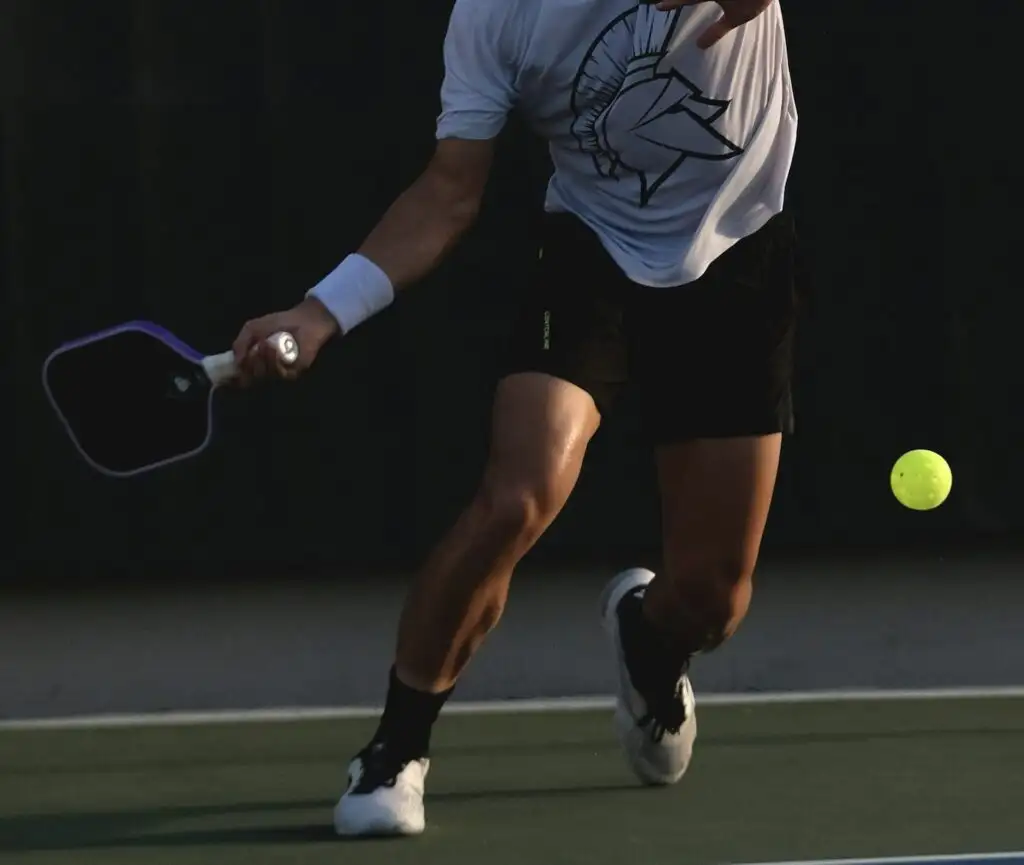

The forehand is one of the most versatile and frequently used shots in pickleball, and for many players, it is their most effective attacking weapon. A properly struck topspin forehand combines pace, control, and consistency to pressure your opponents. Even if you are not a singles player who uses a larger number of forehands, the same fundamental technique is used in doubles for your serves, returns, drives, drops, dinks, and lobs. The topspin forehand is therefore the foundation of your pickleball game.
In this guide, we’ll break the topspin forehand fundamentals down into simple, easy-to-follow steps. From understanding how topspin works and selecting a suitable grip to developing a clean contact and a controlled swing, you’ll learn the fundamentals needed to build a reliable and effective forehand.
Why the Topspin Forehand Matters
What Is Topspin?
The term “topspin” can be slightly misleading because it sounds as though you should strike the top of the ball. Doing that would actually send the ball downward. Instead, topspin is created by rolling the paddle upward and forward against the back of the ball with a low-to-high swing. This friction between paddle and ball causes the ball to rotate forward as it travels through the air. In many ways, “forward spin” like “back spin” would be a more accurate description!
What Does Topspin Do to the Ball?
This forward rotation creates a phenomenon known as the Magnus Effect. As the spinning ball interacts with the surrounding air, it experiences a downward force that causes it to dip faster than a flatter shot toward the court.
Because a pickleball is light, hollow, and perforated, its flight is affected considerably by spin, speed, and wind. Learning to control these variables allows you to play more aggressively without sacrificing consistency. Let’s look at the benefits of topspin in more depth.
What Are the Benefits of Topspin?
Topspin can improve everything on your forehand side, from your serve and return to your drives, drops, dinks, lobs, and passing shots. Its main benefits include:
- Hitting Higher Over the Net – Topspin brings the ball down more quickly, allowing you to aim higher over the net while still keeping your shot inside the court. This creates a larger margin for error and reduces unnecessary net mistakes. A great example is using heavy topspin on your drops to give yourself extra net clearance and therefore more consistency.
- Attacking Your Opponent’s Feet – Using topspin enables you to dip the ball towards your opponent’s feet, pushing them back off the kitchen line and creating spaces and maybe even a pop-up. You can also attack their feet as they move through the transition zone, forcing them back or putting pressure on their shot-making.
- Hitting More Effective Angles – The dipping trajectory of topspin helps you hit sharper cross-court angles inside the lines. You can use it to move opponents off the court with dinks and create space through the middle.
- Hitting with Greater Pace – Because topspin helps pull the ball down, you can accelerate the paddle more confidently without sending the ball long. This makes it especially valuable on serves, returns, dinks and drives.
- Keeping Opponents Back – A deep topspin serve, return, or drive can push an opponent behind the baseline, making it more difficult for them to advance toward the kitchen. Maintaining this positional advantage can give you more time to take control of the point.
- Keeping Drives Lower – Because topspin brings the ball down fast, you can strike your drives with confidence knowing you won’t hit long and can keep the ball low out of your opponent’s attack zone.
- Creating a More Difficult Bounce – Rather than sitting up comfortably, a well-struck topspin ball kicks forward after landing. This can rush your opponent, reduce their preparation time, and make clean contact more difficult. It is especially effective with deep, heavy serves.
- Increasing Your Shot Variety – Once you can control topspin, you can change the pace, height, depth, and angle of your forehand. This makes your game less predictable and gives you more options against opponents in different court positions.
Why Practice A Topspin Forehand?
Beyond the individual benefits of topspin, developing a solid forehand gives you a technical foundation that can be transferred to almost every shot on the forehand side. The full groundstroke itself may be used less frequently, particularly in doubles, but the fundamentals are crucial.
Serve – The traditional volley serve uses a similar forehand motion without the ball bouncing.
Dink/Drop – The dink and drop require a slower, more compact version with greater touch, yet equal amounts of spin.
Lob – A topspin lob uses a steeper upward swing to create height and rotation
Volley – The roll volley relies on a shorter backswing and a compact topspin action to keep the ball low.
Learning the complete forehand, therefore, gives you more than one effective shot. It teaches a versatile movement pattern that supports your entire forehand game. Once you understand how to adjust the length, speed, angle, and trajectory of the swing, you can apply the same fundamentals across the court with greater confidence and consistency.
The Forehand Grip
Pickleball primarily uses three forehand grips: Continental, Eastern, Western.
- Continental — less topspin, more power, lower contact point
- Eastern — balanced spin and power, mid-height contact
- Western — heavy topspin, less power, highest contact
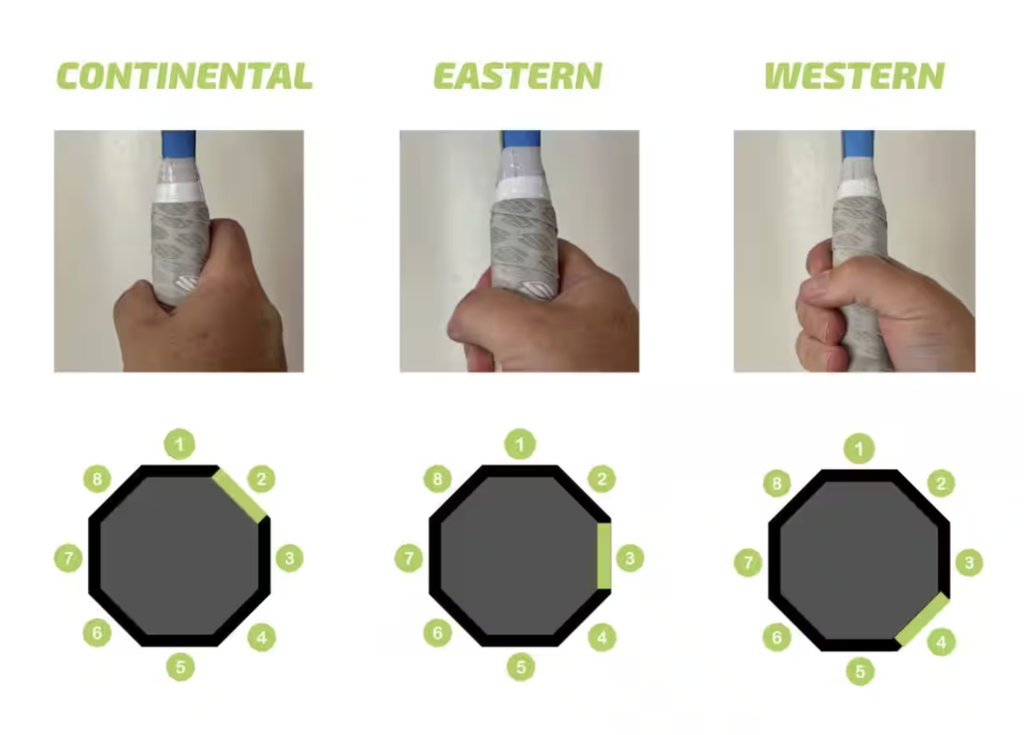
For a deep dive on the forehand grips, read our article How To Find The Best Pickleball Grip
1. The Continental Grip
The continental grip is the one most coaches recommend beginners start with, and for good reason. You don’t need to switch your grip between shots…it’s the only grip that lets you do that. In a fast kitchen exchange, the last thing you want to be thinking about is repositioning your hand. The continental grip lets you react instinctively. It’s the most versatile grip in pickleball. However, Continental doesn’t allow you to apply topspin as easily as other grips.
What It’s Great For:
- All shots
- Fast exchanges (hand battles)
- Fast changes from forehand to backhand side (volleys, dinks)
- Slice (both forehand and backhand sides)
- Can reach lower shots more easily
How To Find The Continental Grip
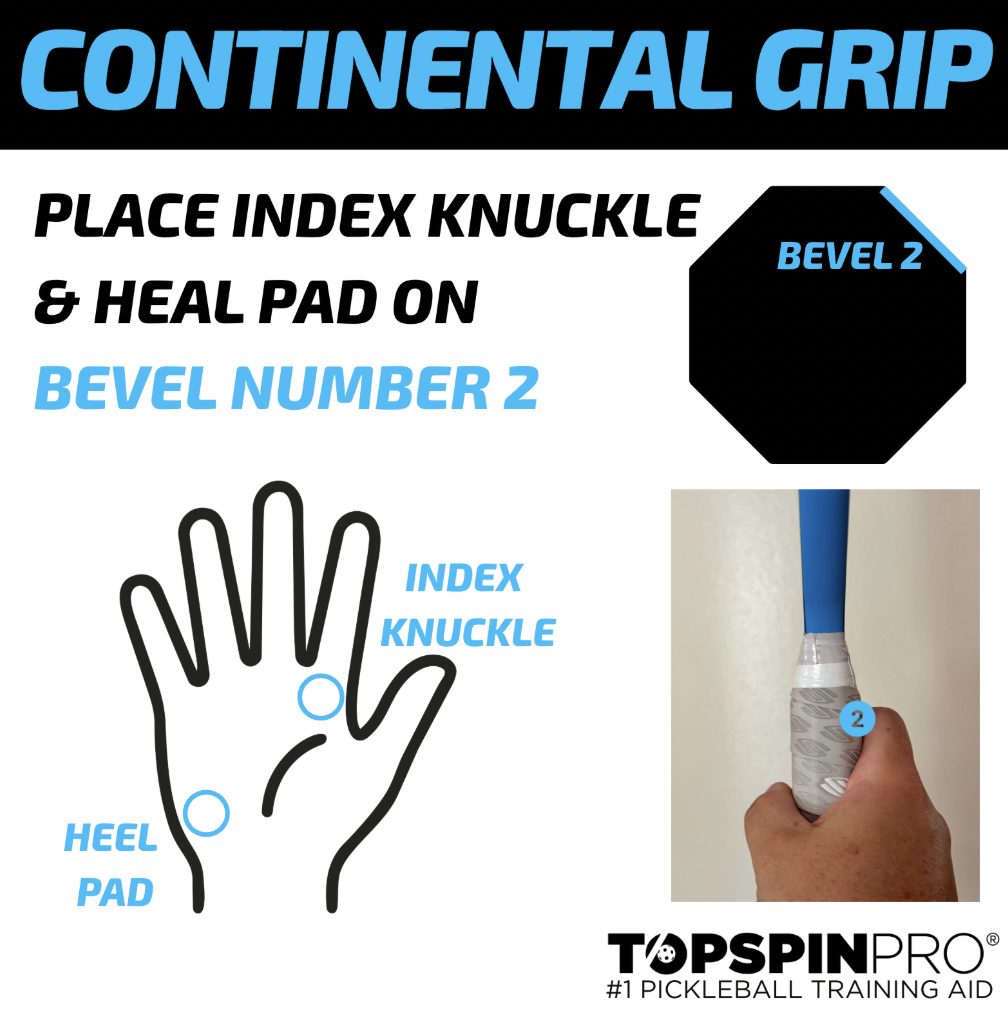
To find it, hold the paddle as if you were hammering a nail, with the edge facing straight down. Also, the base knuckle of your index finger and the heel pad should sit on bevel number 2.

2. The Eastern Grip
The eastern grip requires you to move your hand a little farther around the back of the handle, shifting your natural contact point a bit farther out in front. This suits forehand drives, drops, and dinks, and enables you to more naturally generate some topspin. It also helps you get more spin on your volleys and serves.
What It’s Great For
- All forehand side shots (serve, return, drive, drop, dinks, volleys, and lob)
- Enables a faster transition from forehand to backhand grip than the Western grip.
How To Find The Eastern Grip
The base knuckle of your index finger should sit on bevel number 3.
3. The Western Grip
If you are coming from tennis, the pickleball western grip is equivalent to the semi-western. It turns the hand around another bevel towards the back of the paddle, forcing the contact further out in front. It’s great for generating topspin but limits your ability to handle lower balls.
What It’s Great For
- Heavy Topspin shots that don’t require a fast grip change (serve, lob, high volleys)
- Singles play that requires more groundstrokes with topspin
How To Find The Western Grip
The base knuckle of your index finger should sit on bevel number 4.
The Forehand Technique – Setup
Ready Position
The ready position is where every shot begins and ends. A poor ready position leads to slower reactions and late contact.
A good ready position is similar to defending in basketball. Stay on your toes with your weight forward, knees slightly bent, heels off the ground, and ready to move in any direction. Hold the racket comfortably in front of your body, with your non-hitting hand on the throat or both hands on the grip.
Split Step
The split step is a small hop taken as your opponent contacts the ball. It loads your legs, shifts your weight onto the balls of your feet, and helps you react quickly rather than move from a standstill.
Timing is crucial and split at the moment your opponent makes contact, not before or after. Too early and you’ll lose the loaded position. Too late, and you’ll react slowly.
Footwork
Your footwork is the foundation of a good shot. You can have the best technique in the world, but if you are either not ready to react or have inefficient footwork to the ball, then it doesn’t matter how good that technique is.
There are two main types of movement in pickleball:
- Closing down the space (moving to the ball)
- Creating space (moving away from the ball)
You can also close down or create space in all directions, and you want to try to be equally good at all of those. Pickleball is a sport that requires quick movement forward, backward, and side to side. If you struggle with confidence in your movement, then you will struggle to implement good technique.
The Forehand Technique – Swing
The Backswing
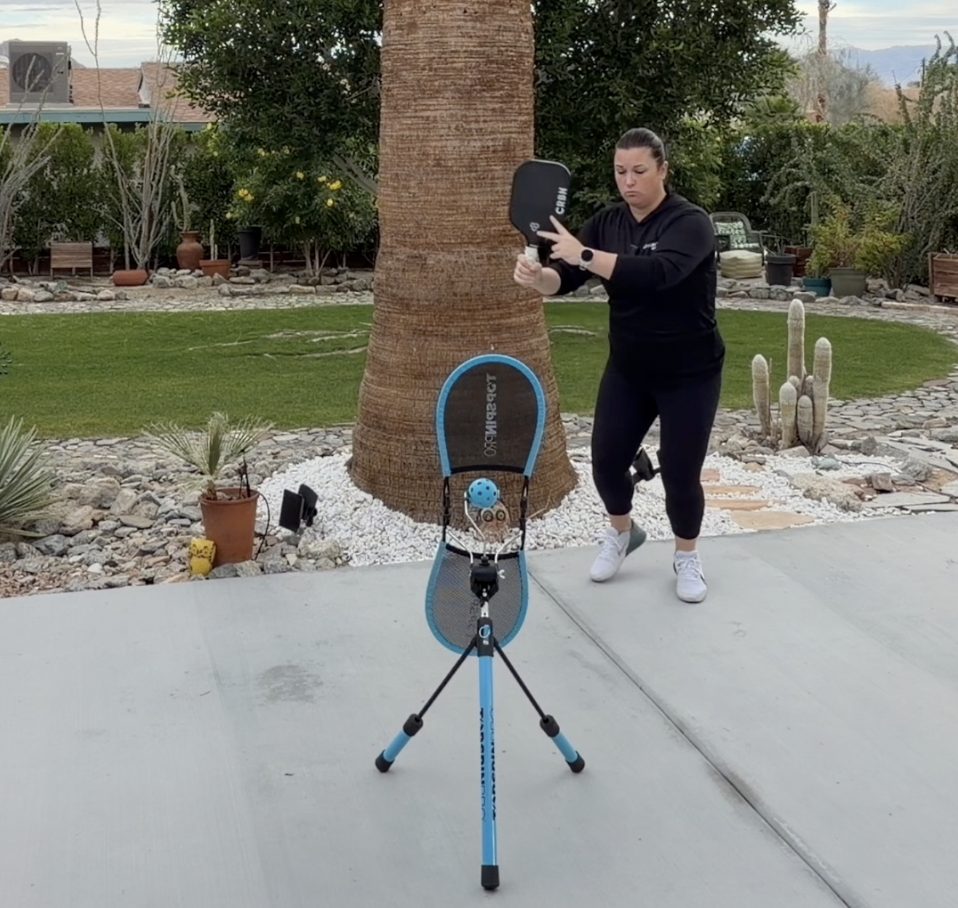
As you see the ball coming, turn your shoulders to the side as a unit with your paddle, bringing your paddle back, ideally slightly higher at first. This is known as a unit turn. Keep your non-playing hand on the paddle until your shoulders turn, and then let go, once you have turned your shoulders to the side.
The Drop
Next, relax and let your arm and paddle drop down naturally so that the paddle face points slightly to the ground, not the side of the court. So, from the beginning of the backswing to the drop, and then the forward swing, it looks like you’re drawing a letter “C” with your paddle. At this point, you want to keep your arm and wrist nice and loose. The looser you keep it, the faster you can swing your paddle forward to the point of contact.
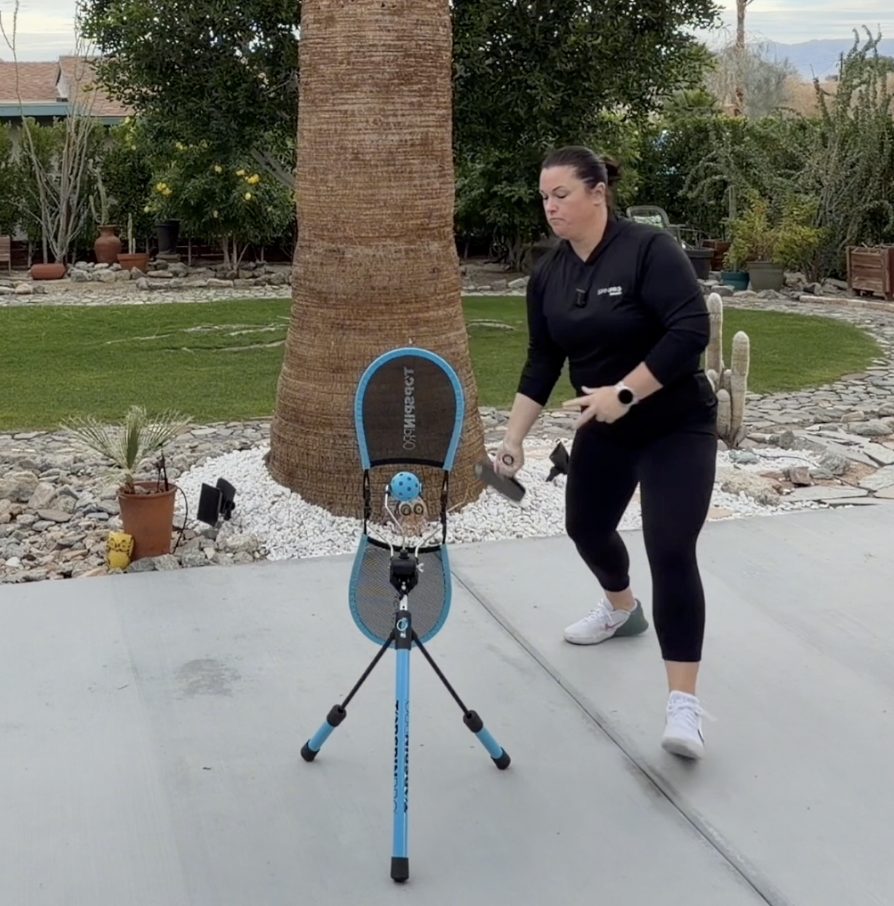
The Forward Swing
Once you begin swinging forward, your paddle should be below the contact point so that it can travel up the back of the ball at impact.
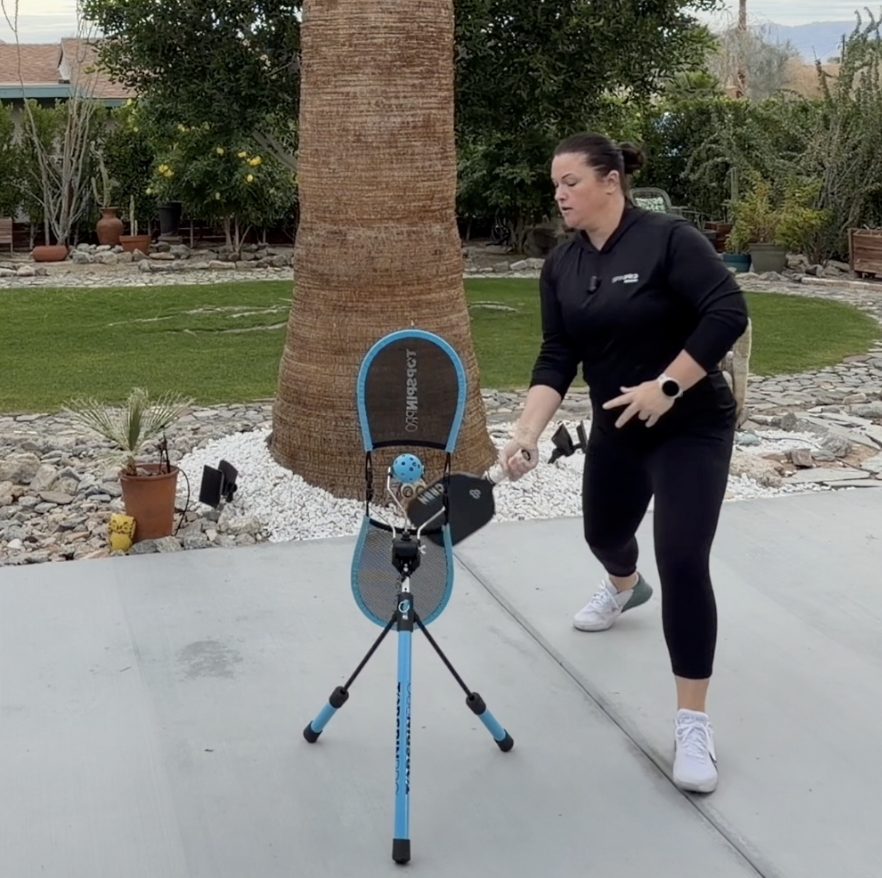
The Contact Point
Step forward with your leading foot (non-dominant), and turn your hips and shoulders back towards the net. Contact the ball out in front of your body so your weight can shift through the ball. Hips and shoulders should face back toward the court at contact.
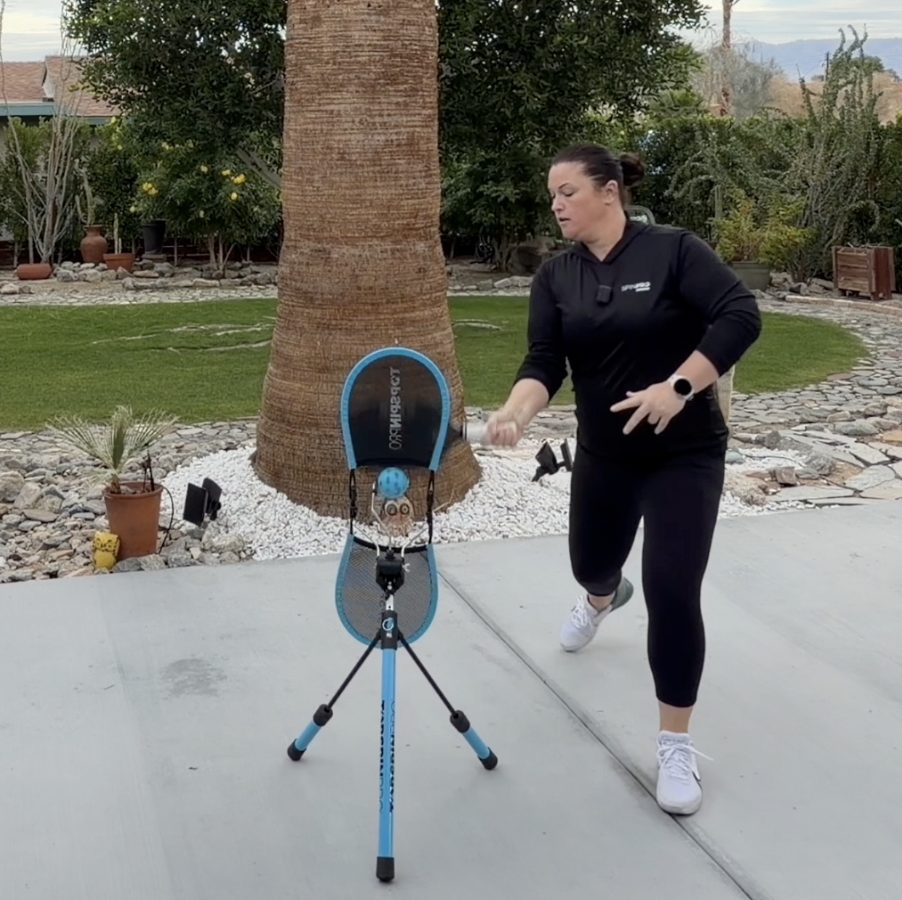
The Follow-Through
Your forehand swing should naturally keep accelerating through to the finish position. Try not to decelerate and stop short. This will reduce your power. You should finish with your paddle high and your body facing the court. A good rule of thumb is to point your elbow (at the end of your swing) where you would like the ball to go. This is easiest if you land your paddle over your shoulder, with the edge facing down.
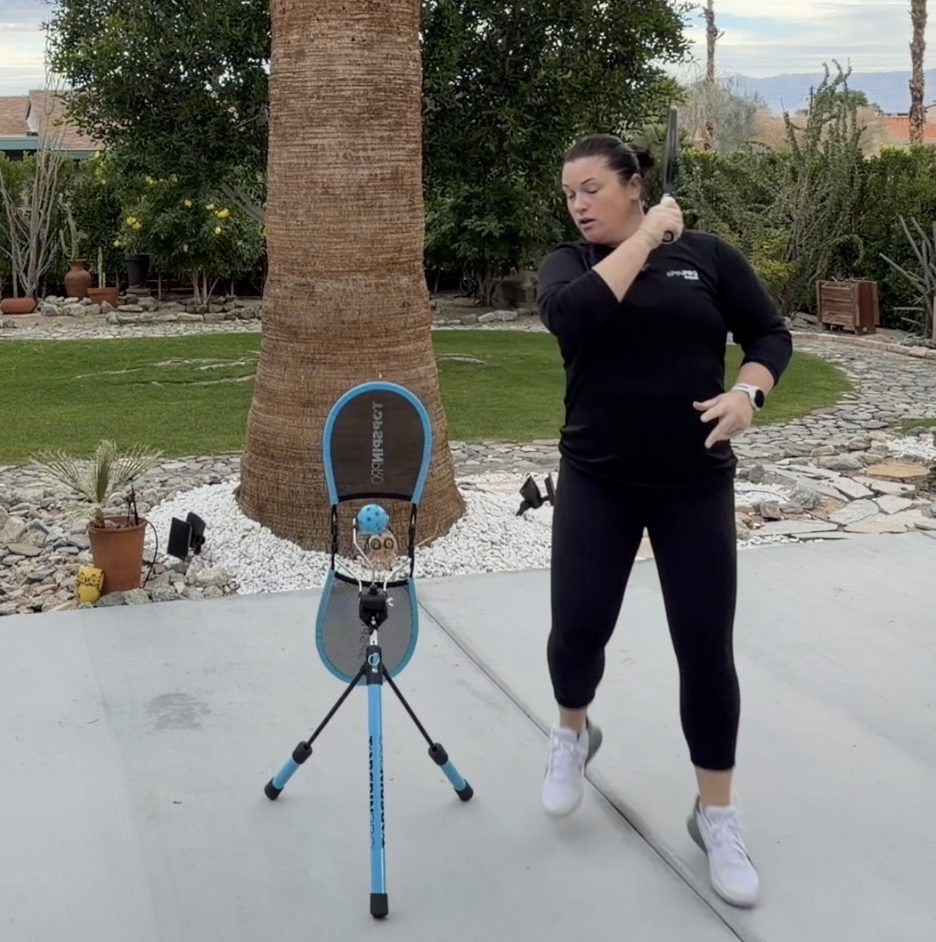
What is the Kinetic Chain & Why is it Important?
Have you ever wondered how a relatively small player can hit the ball with so much power? The secret is the kinetic chain, the way your body links together to generate and transfer energy.
Power comes from the kinetic chain in this sequence:
Ground → Legs → Hips → Torso → Shoulder → Arm → Racket
It starts with you pushing into the ground. As your legs drive down, the ground pushes back, and that force travels up through your body.
Each link then rotates in turn: the hips turn first, then the torso, shoulder, arm, and finally the paddle. As each larger, slower segment reaches its peak speed and begins to slow, it passes its momentum on to the next, lighter one, which speeds up even more.
It works like cracking a whip: the energy builds through the chain so the paddle head ends up moving far faster than any single body part could manage alone.
If any link breaks, such as poor hip rotation or relying only on the arm, you lose much of your potential power. That’s why good footwork and positioning are essential; they allow you to load the body properly before the swing even begins.
Common Pickleball Forehand Mistakes
1. Gripping Too Tight
This is the most common mistake among adult players. Gripping the handle too tightly can cause injuries, reduce your paddle head speed, and reduce ball control and spin. The ability to adjust your grip pressure for different shots will push your game to the next level.
2. Big Backswing
It’s all too tempting to take a huge backswing when you have time, but pickleball requires a fast recovery between shots. Pickleball’s smaller court and faster exchanges demand compact preparation. Taking the paddle too far behind your body can make your contact late and reduce your control.
3. Arming The Ball
Swinging entirely with the arm limits both power and consistency. Use the kinetic chain and initiate the stroke with your legs and hips, rotate your torso, and allow that energy to transfer naturally through your shoulder, arm, and paddle.
4. Making Contact Too Late
Allowing the ball to travel alongside or behind your body causes cramped contact and poor directional control. As already mentioned, this can result from a large backswing or poor footwork and preparation. Prepare early and strike the ball comfortably in front of your body.
5. Forcing The Topspin
Topspin should come primarily from the low-to-high path of the paddle rather than a sudden wrist movement. Excessive wrist action changes the paddle angle at impact, leading to inconsistent contact points.
6. Opening the Paddle Face
An overly open paddle face sends the ball too high, causing it to sail beyond the baseline or into your opponent’s attack zone. Maintain a neutral or slightly closed face, depending on the height of the ball and the amount of topspin you want to produce.
How To Improve Fast
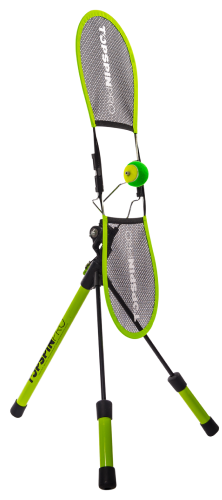
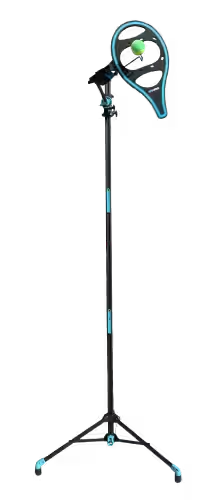
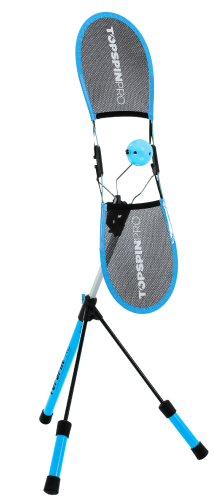
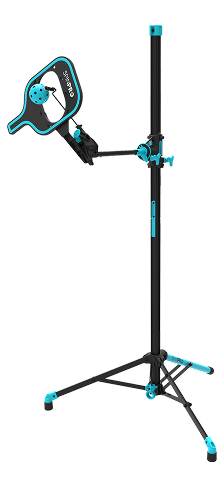
If you are unsure of how to practice the above technique, you can try breaking it down into stages on either the TopspinPro or the SpinPro. Here’s a demo video showing you how:

Conclusion
A reliable topspin forehand can completely transform your pickleball game, giving you the confidence to attack while still keeping the ball under control. Better yet, once you understand how to create topspin, you can use the same core movement across your entire forehand game from serves and drives to roll volleys and dinks.
Remember, topspin isn’t created by forcing the racket over the ball or flicking your wrist. It develops naturally from sound technique. Efficient footwork and spacing, early preparation, a relaxed arm, and a smooth low-to-high swing. Build those foundations first, and the spin, power, and consistency will follow.
Keep practicing, enjoy the process, and before long, your forehand won’t just keep you in the rally, it will become one of your biggest weapons!
Enjoyed this article?
Be sure to sign up for our newsletter and we'll keep you up to date about new posts