
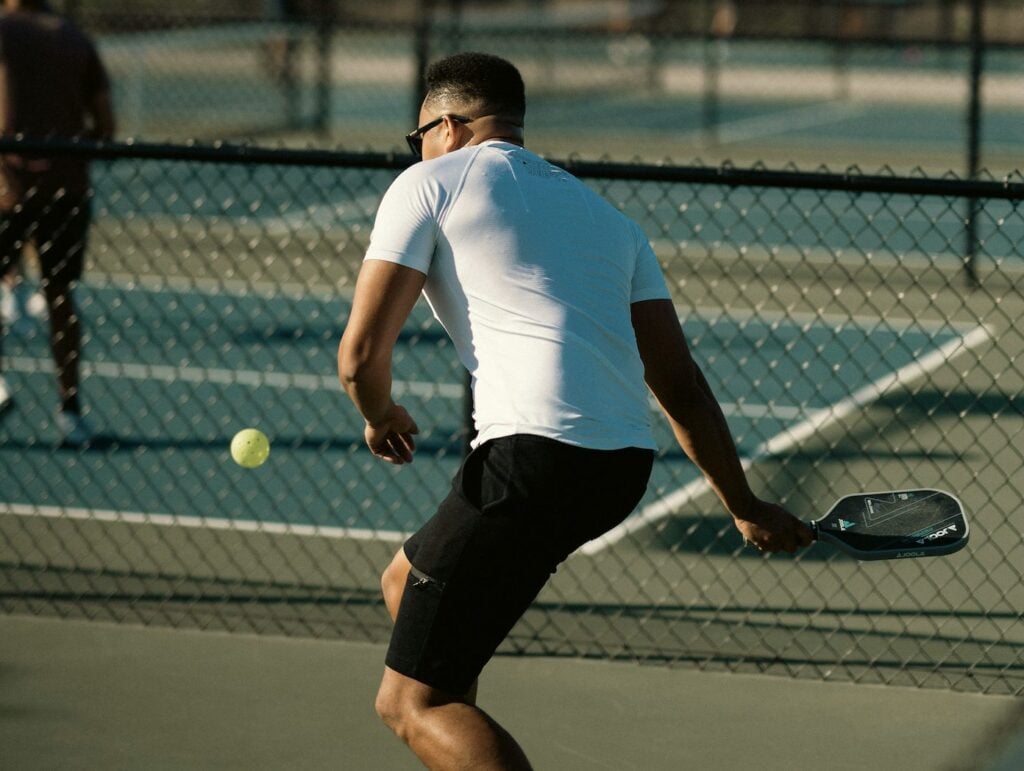

The drop is one of the most important and strategic shots in pickleball, yet often one of the most frustrating to hit well. It takes a lot of confidence and repeated practice to get it feeling consistent. But, once you get there, the drop can not only keep your opponents on the defensive, it can also put you back in a position of attack!
In this article, we’ll deep dive into the drop, the mechanics of a successful shot, key techniques, and strategies to make the drop a reliable part of your pickleball game. We will also look at the differences between the flat, topspin, and slice drops.
Understanding the differences between these variations and knowing when to use each can help elevate your game to the next level.
What Is a Pickleball Drop?
The drop is usually hit from deeper in the court and is primarily used to transition from the backcourt (the area near the baseline) to the non-volley zone (the kitchen) or to reset the ball. If hit well, the ball lands in the kitchen area in such a way that the opposing team can’t attack it. This allows you time to move up to the kitchen and get into a better tactical position.
The drop is often discussed in terms of the third shot because the serving team commonly hits it after the return. However, it can also be played as a fifth-shot, seventh-shot, or later transition drop.
You will not always reach the kitchen after one drop. It may take several drops and resets before you can advance all the way up, depending on the quality of the shot you have hit.
What Are The Benefits of a Pickleball Drop
Dropping the ball instead of driving or lobbing helps you stay consistent while putting pressure on your opponents. The drop helps you neutralize opponents positioned at the kitchen line and prevent opponents from attacking the next ball. It also gives you a way to move safely from the baseline toward the net, change the speed and rhythm of the rally, especially against bangers, and reset the point when you are under pressure.
What Makes a Good Drop?
A good drop clears the net safely before descending into the kitchen. After bouncing, the ball should remain in a position that is harder to attack. See “Where to Aim” later in the article.
The ideal drop has:
- Good Height – A drop that travels too close to the net is risky. It wants to clear to a height that avoids the net while staying out of the opponent’s easy volley zone.
- An Arc Shape: The ball should be dropping as it crosses the net so that it doesn’t stay too high and become easy to attack.
- Depth: It should land deeper in the kitchen or close to your opponent’s feet so that it cannot be attacked comfortably.
Types of Pickleball Drop
Although every drop has the same basic objective, getting the ball into the kitchen and preventing an attack, the shot can be hit in a variety of ways. The three main variations are the flat, topspin, and slice drop. We will talk about how to hit each of these drops later in the article.
1. The Flat Drop
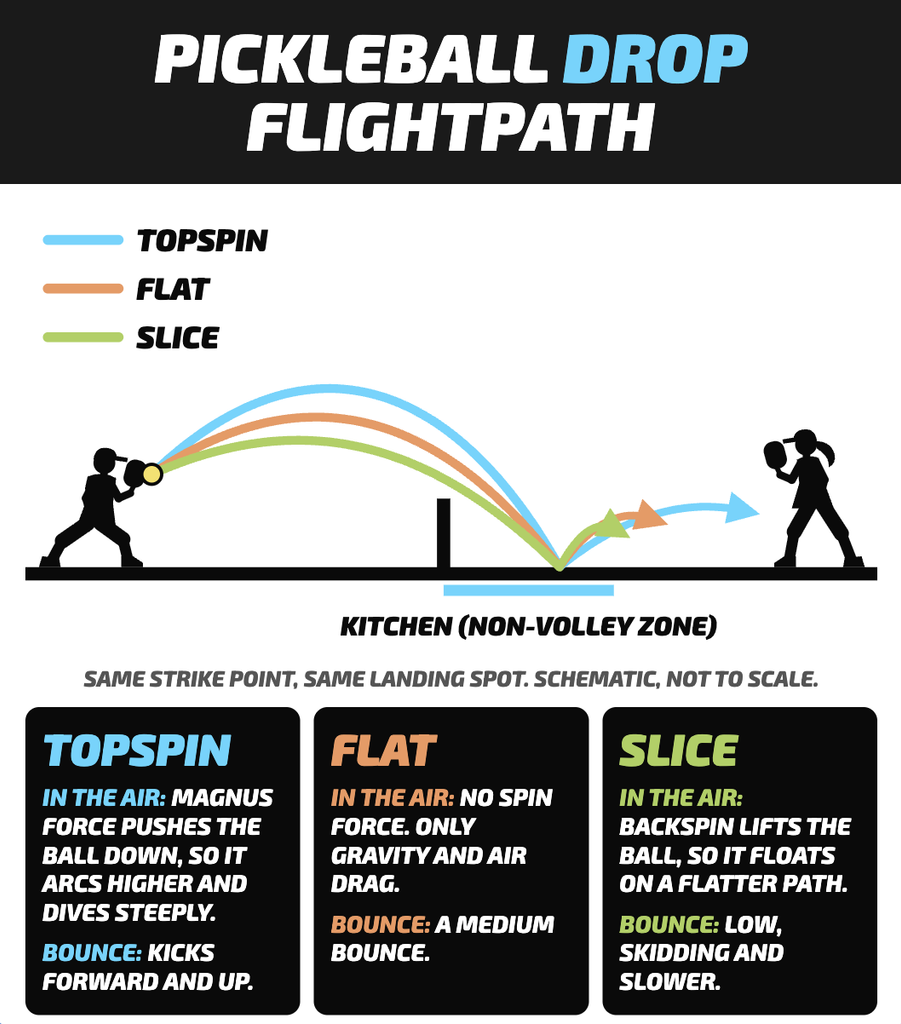
The flat drop uses no intentional spin, although it is physically impossible to hit with no spin at all, so there will always be a little spin on the ball. The shot wants to be played with a slightly open paddle face and a smooth lifting motion that sends the ball up in a gentle arc over the net.
The flat drop is usually the best for beginners because it uses simple mechanics and is the easiest to hit. It is also useful under pressure when you are short on time and need a simpler, more dependable shot rather than an aggressive one.
2. Topspin Drop
The topspin drop is produced by rolling the paddle up the back of the ball. The forward rotation created by this action causes the ball to dip more quickly after crossing the net and kick slightly forward and up on the bounce. This is known as the Magnus Effect.
Because topspin helps pull the ball down, you can use slightly more pace and height than a flat drop and still keep the ball landing in the kitchen. The steeper flight path and kick on the bounce pressure the opposing team’s timing, and often result in late or jammed contact points.
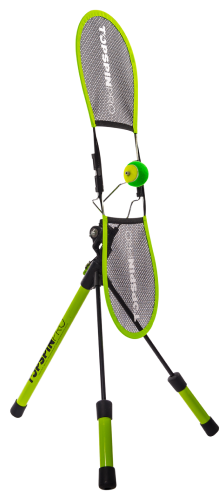
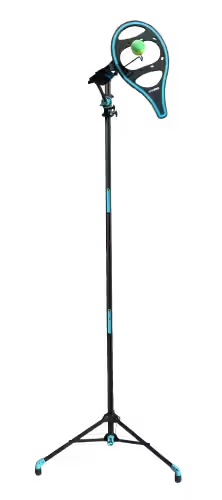
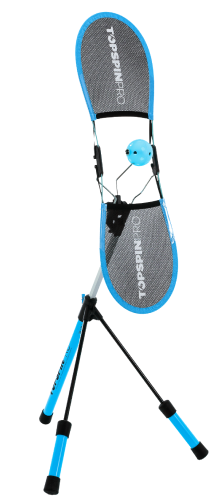
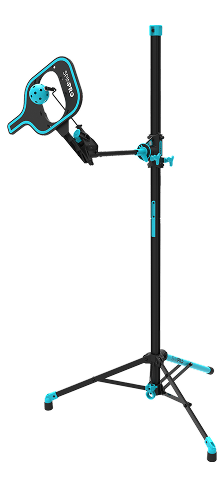
The video below shows you how you can practice topspin drops both at home and on court using the TopspinPro. The same practice can be used with the SpinPro.

3. Slice Drop
The slice drop uses backspin (the opposite of topspin), which is created by rolling the paddle down the back of the ball and lifting the paddle slightly forward at the finish. A slice drop normally travels more slowly and floats lower than a topspin drop across the net. The bounce also skids off the ground lower, often making the ball awkward to judge.
Slice is particularly useful for absorbing pace and changing the rhythm of a rally. Its slower flight may also provide additional time to recover and move forward.
4. BONUS SHOT: The Drip
The drip is a shot that combines a drive with a drop. It’s basically a more aggressive topspin drop. Once you get confident with hitting topspin, you can add that extra pace to force more pop-ups.
Choosing the Right Drop
Once you can hit every type of drop, it can often become confusing to know which one to hit when. Many players also tend to have a favorite type that they resort to when under pressure or when not feeling confident. Making the right choice generally depends on the incoming ball and your court position. It’s not just about which one you feel like hitting.
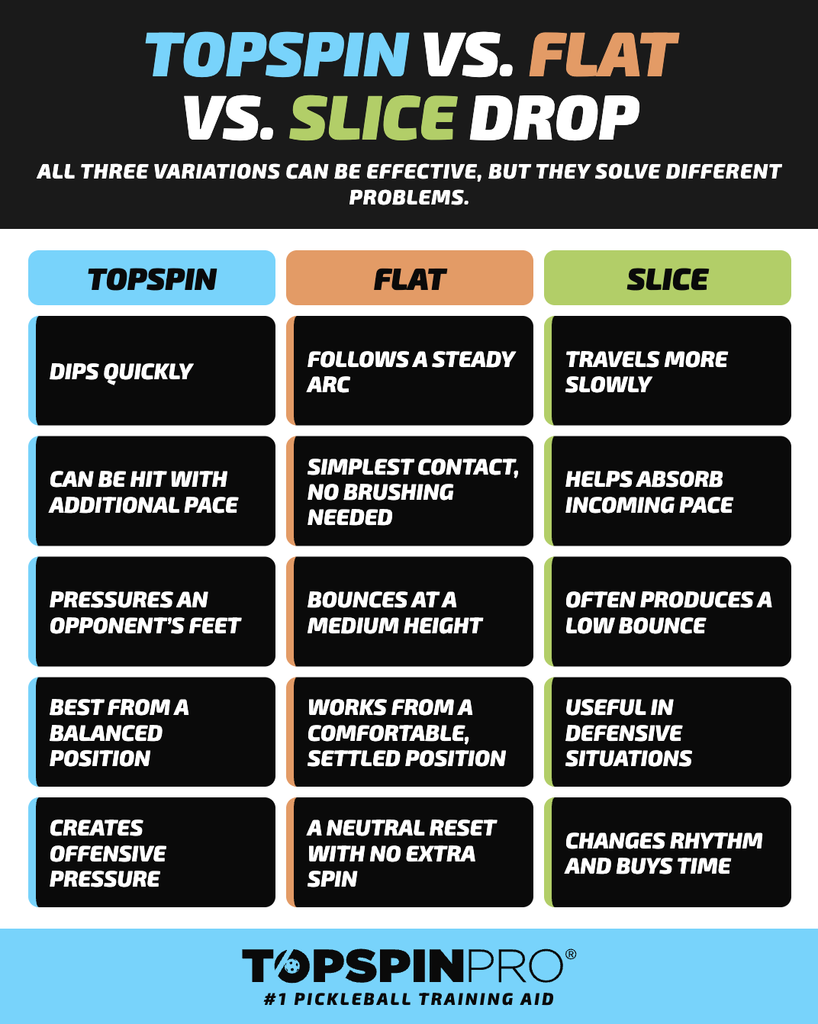
- Flat Drop – Use when consistency is the priority.
- Topspin – Choose topspin when you are balanced and want to create additional dip and pressure.
- Slice – Use slice when you are absorbing pace, changing the rhythm, or playing from a more defensive position.
You do not need to add heavy spin to make a drop effective. Placement, height, and control remain more important than the type of rotation on the ball.
The Drop Grip
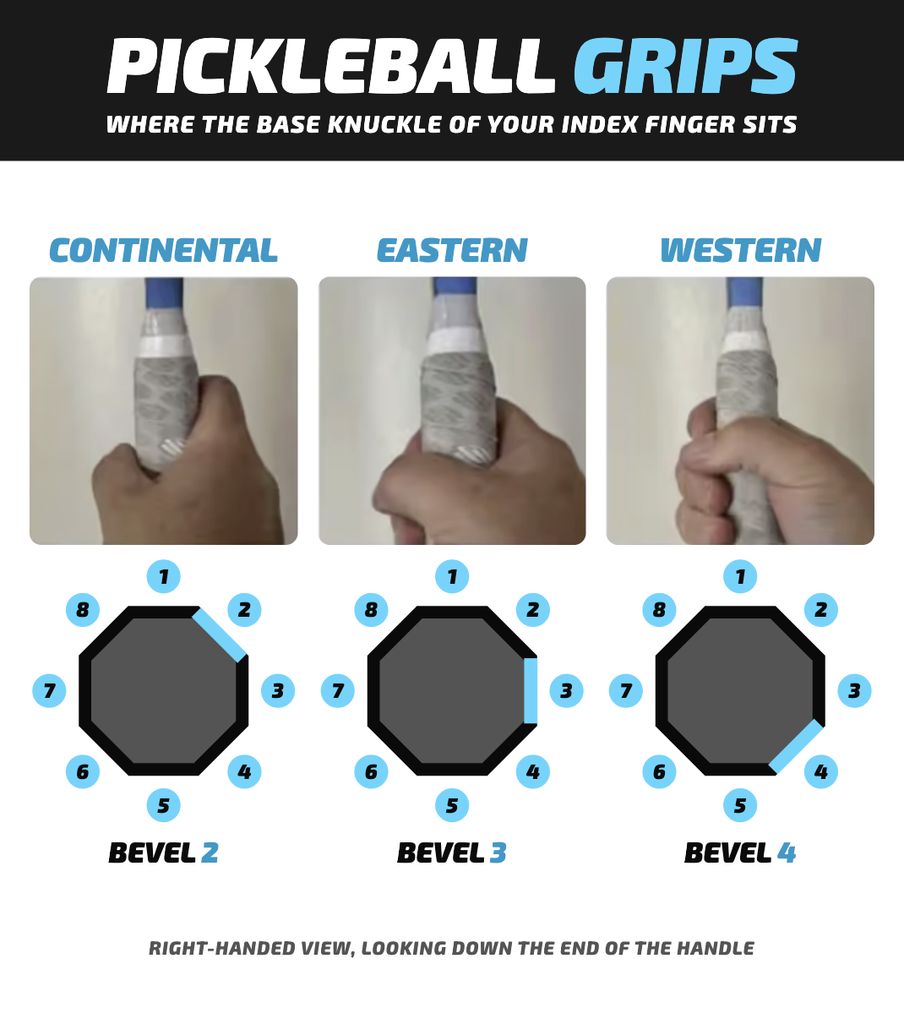
The continental grip is the best general grip for hitting all types of drop shots, especially for beginners. It enables a quick transition from shot to shot without changing grip. If you have a preferred grip for the forehand or backhand side, then use that.

Pickleball primarily uses three main grips on the forehand side: Continental, Eastern, Western.
- Continental — less topspin, more power, lower contact point
- Eastern — balanced spin and power, mid-height contact
- Western — heavy topspin, less power, highest contact
For a deep dive on all of the grips, read our article How To Find The Best Pickleball Grip
The Drop Technique – Setup
Ready Position
Good pickleball technique starts before the ball travels toward you. If you aren’t ready for the incoming ball, then it doesn’t matter how good your technique is. Focus on recovering fast after every shot you have played to give yourself maximum preparation time before the next shot.
Keep your feet active, your knees slightly bent, and your body weight over the front of your feet. Ideally, your heels should be off the ground so you are ready for fast changes in direction. Position the paddle in front of your body and around chest height. Your free hand may support the paddle near the throat, or you can place both hands around the handle.
Split Step
The split step is a short, controlled bounce that prepares your body to react. As the opponent strikes the ball, briefly leave the ground and land with your feet apart, knees flexed, and weight balanced over the balls of your feet.
This landing loads your legs and helps you push off in the direction required rather than starting from a sluggish, stationary position.
Correct timing matters. Aim to land as soon as you see the direction of the opponent’s shot.
Footwork
Your footwork after the split step is the foundation of a good shot. As we have already said, you can have the best technique in the world, but if you are either not ready to react or have inefficient footwork to the ball, then it doesn’t matter how good that technique is.
There are two main types of movement in pickleball:
- Closing down the space (moving to the ball)
- Creating space (moving away from the ball)
You can also close down or create space in all directions, and you want to be equally good at all of them. Pickleball is a sport that requires quick movement forward, backward, and side to side. If you struggle with confidence in your movement, then you will struggle to implement good technique.
If you are interested in improving your footwork and general pickleball fitness then you can sign up for our Pickleball Fitness Course here.
The Drop Technique – The Swing
The Backswing
As you move toward the ball, turn and prepare your paddle. A late backswing will equal a late contact. It’s better to be too early in your preparation than too late. Use a compact backswing to help with preparation speed.
Also, think about the two types of movement. Are you moving toward the ball or away from it to create space as you start your backswing? Efficient spacing helps set up a good backswing.
The Drop
Drop the paddle into the low part of the backswing so you are getting down to the ball. Bend your knees to help you reach lower. This helps you lift the ball with control and maintain your balance through contact. Your legs should contribute to the shot.
The Forward Swing And Contact
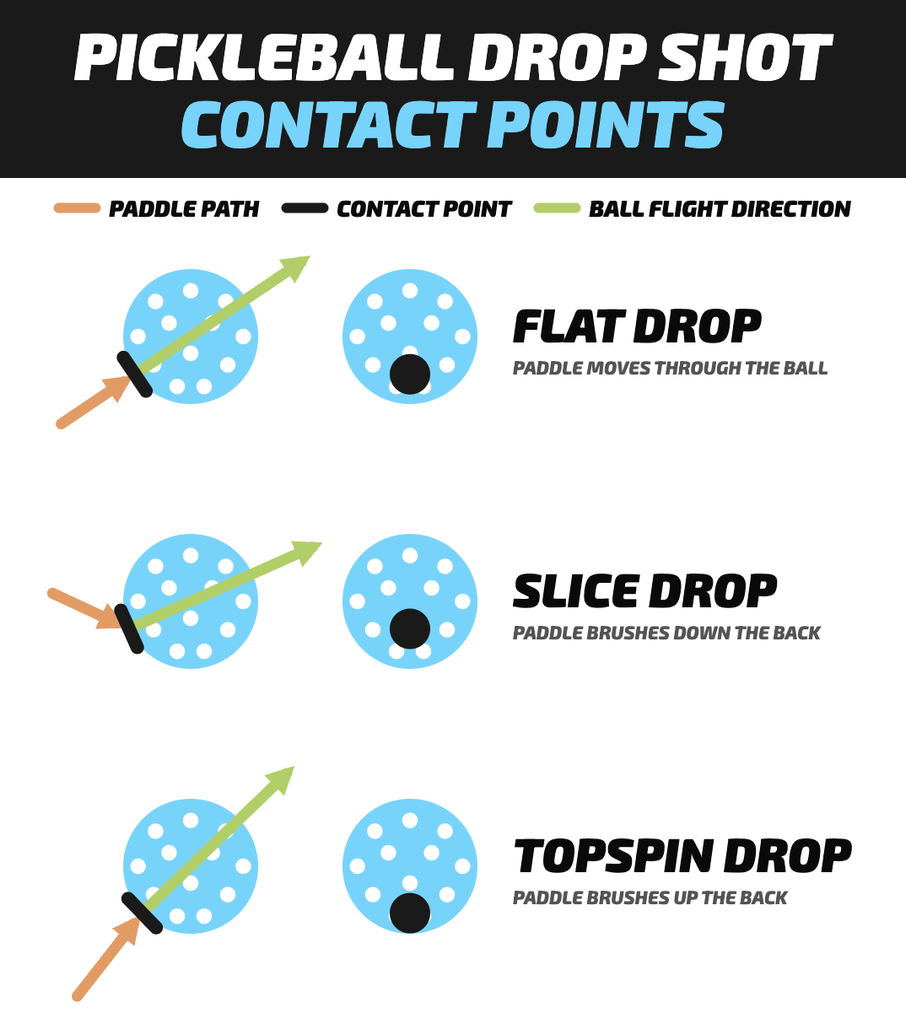
The forward swing is where the technique starts to differ depending on what type of drop you are hitting. For a visual of the correct contact point, see the image below:
1. Flat Drop Technique
The paddle face direction sets the ball launch angle. Keep it slightly open for a standard drop so the ball travels upward before descending into the kitchen. Focus on contacting the ball underneath to send it upward.
Avoid flicking your wrist at contact. The wrist should remain relatively sturdy as the shoulder and arm guide the paddle forward. Swing from low to high, aiming to lift the ball up to at least double net height.
2. Topspin Drop Technique
Begin with the paddle below the ball, then brush it up the back of the ball. The objective is to get the ball rolling forward as much as possible.
The paddle should travel from low to high, finishing above the contact point. Accelerate smoothly rather than trying to add spin with a sudden wrist movement.
3. Slice Drop Technique
Begin with the paddle above with the ball, then move gently forward and underneath it.
The swing should be controlled rather than too steep. Chopping sharply downward can send the ball into the net.
Let the paddle continue toward the target after contact. The forward movement provides distance, while the brushing action underneath the ball produces backspin.
The Finish
Whichever type of drop you are hitting, you want to finish above the contact. On the flat and topspin drop, aim for a nice high finish around shoulder height or above. For the slice drop, think of extending and floating the finish forward and up.
Recover
After hitting the drop, watch the quality of your shot before choosing to advance quickly up the kitchen. Whichever direction you are moving, ensure you recover fast into your ready position.
If the drop is unattackable, move forward. If it sits high or in an easy-to-hit area, stop and prepare to defend. Use a split step as your opponent makes contact, so you are balanced and ready for the next ball.
Where To Aim
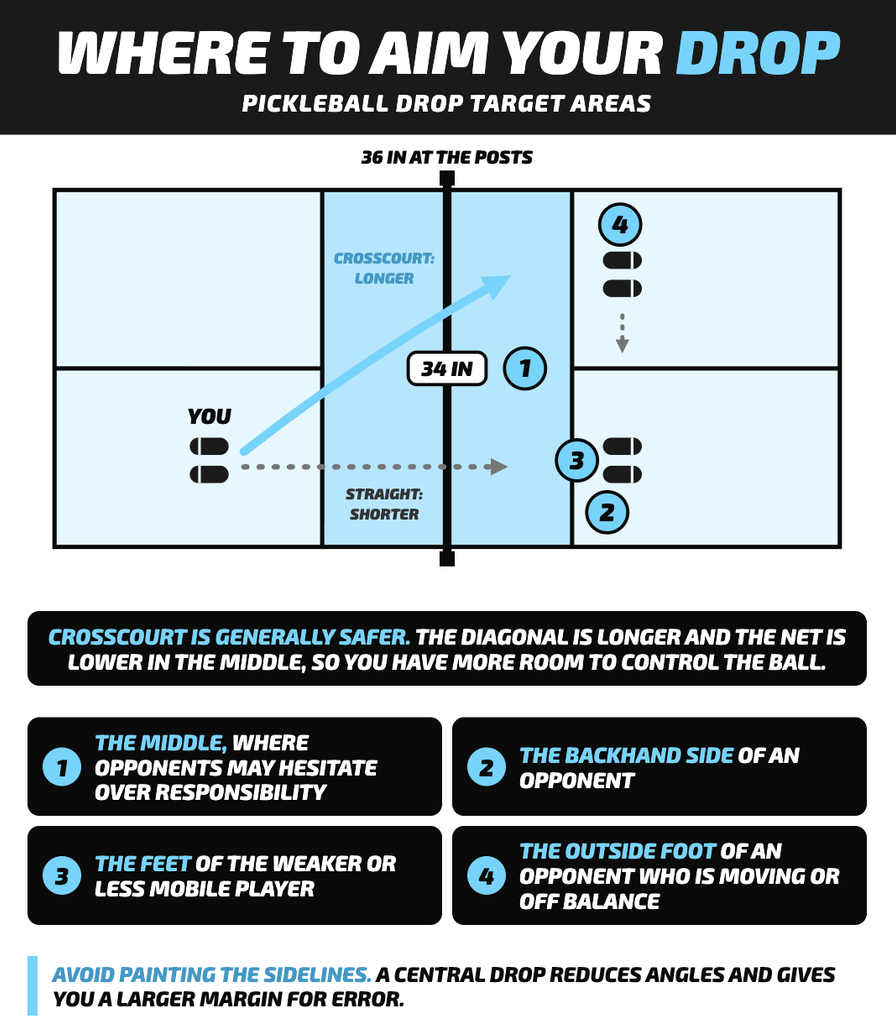
When you hit a drop, the best place to aim is often crosscourt. The diagonal across the court is longer than the straight line, and the net is lower in the middle, so you have more distance to work with and more room to control the ball.
From there, look for targets that make your opponents uncomfortable. The middle of the court is a good one because opponents may hesitate about who is responsible for the shot.
You can also aim at an opponent’s weaker side, often the backhand, or at the feet of the weaker or less mobile player. Also look for spaces and opportunities, such as at the outside foot of an opponent who is moving or off balance. Avoid trying to paint the sidelines. A central drop reduces the angles your opponents can use and gives you a larger margin for error, which makes it one of the most effective choices you have.
Common Drop Mistakes
1. Not Enough Height
Players often believe that a good drop must barely clear the tape. This produces too many errors in the net. It is better to hit it too high into your opponent’s attack zone than lose the point in the net.
Being tight or nervous can also send the ball lower over the net. Be confident and give the ball adequate net clearance.
2. Too Much Wrist
Excessive wrist movement results in an inconsistent paddle face at contact. Don’t try to force the spin. Keep your wrist stable and guide the swing with the shoulder and arm.
3. Large Backswing
A large backswing creates unnecessary speed and can also often result in a late contact point. It’s tempting when you want to add more spin to take a bigger swing. Try to use compact preparation and smooth acceleration.
4. Tight Grip
One of the most common problems is gripping the handle too tightly. Tension reduces feel and makes distance control harder. Relax your hand and maintain light pressure through contact. Imagine you are holding a raw egg that you don’t want to break.
5. Moving Forward Too fast
Do not charge toward the kitchen after every drop. Advance only when the shot prevents your opponent from attacking. If the ball is high, stop, split step, and prepare to defend.
Final Thoughts
A consistent drop can completely transform your confidence. An attacking drop can win you a lot of points. A combination of both will take your game to the next level.
Creating a safe route to the kitchen gives you the chance to take control of the rally, whether you have hit a natural or more aggressive drop. The secret is not hitting the flashiest shot, it is choosing the right height, trajectory, and placement needed.
Remember, the drop is not a standalone shot, it is the beginning of your journey forward and onto the next chapter of the point. Hit it, read your opponent’s response, and advance only when the opportunity is there. Commit to the process, practice with purpose, and your drop can become a powerful weapon that turns defensive positions into control of the kitchen.
Enjoyed this article?
Be sure to sign up for our newsletter and we'll keep you up to date about new posts